Vacuum units
Vacuum pressure and units explained: kPa, mbar, inHg and what −0.6 bar means for a tube lifter
Compiled from public standards and manufacturers' published data.
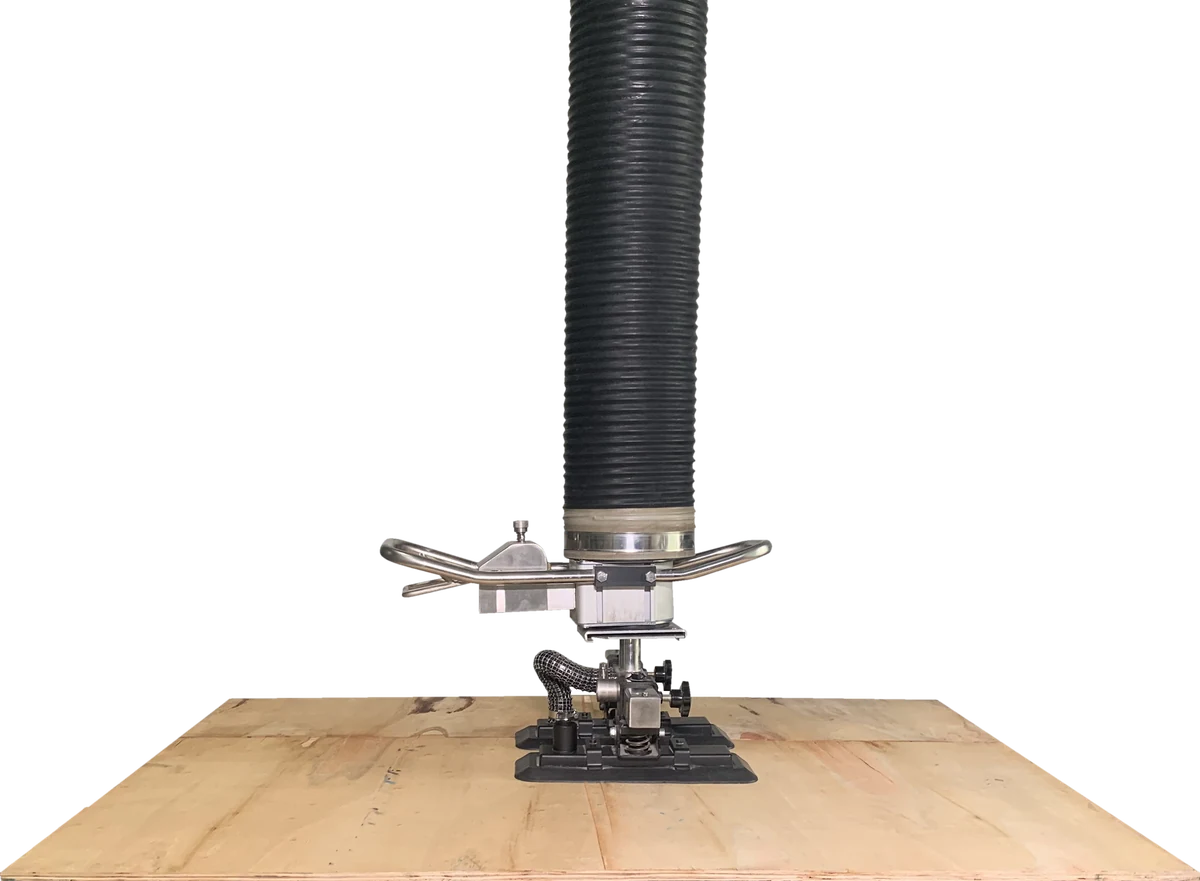
A vacuum lifter data sheet may say −0.6 bar, 60% vacuum, 600 mbar vacuum or about 41 kPa absolute, and a US gauge may read 17.7 inHg; all five describe the same condition. This page explains the three ways a vacuum is stated, converts the units that appear on data sheets and gauges, says what working vacuum a vacuum tube lifter actually uses and why, and shows how to read the gauge and the alarm point. It is written for buyers comparing quotations and for the technicians who will check the machine; the lifting force those pressures produce is worked out on the capacity calculator, not here. Our vacuum tube lifters are rated by load per the catalogue, and the pressure figures below are industry values, not a rating.
Absolute, gauge and percentage: three ways to state one vacuum
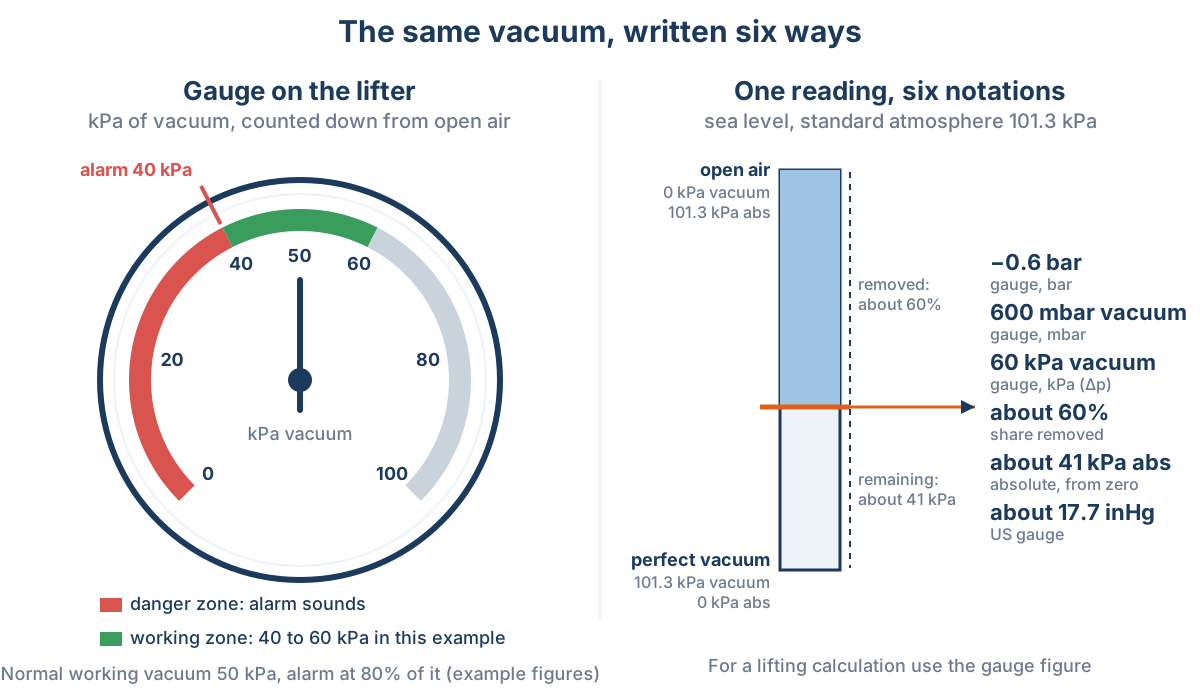
Air at sea level presses with about 101.3 kPa, which is 1,013 mbar, 29.9 inHg or 14.7 psi; that is the standard atmosphere, and every vacuum figure is measured either against it or against zero. Absolute pressure counts up from zero: a perfect vacuum reads 0 and open air reads about 101 kPa, so a generator sheet that says "40 kPa abs" is stating the pressure left inside the system. Gauge pressure, also called relative or vacuum pressure, counts down from the surrounding air: open air reads 0 and the figure is negative or carries the word vacuum, so −0.6 bar, 600 mbar vacuum and 60 kPa vacuum are one and the same reading. Percentage vacuum divides the gauge reading by the standard atmosphere, so 60 kPa of vacuum is about 60% and a perfect vacuum is 100%.
| Notation | Reading | What it counts |
|---|---|---|
| Gauge, bar | −0.6 bar | Below the surrounding air |
| Gauge, mbar | 600 mbar vacuum | The same, in thousandths of a bar |
| Gauge, kPa | 60 kPa vacuum, the Δp of a lifting calculation | The same, in SI units |
| Percentage | about 60% vacuum | Share of the standard atmosphere removed |
| Absolute | about 41 kPa abs, that is 101.3 minus 60 | Pressure remaining, counted from zero |
| US gauge | about 17.7 inHg | Below the surrounding air, in inches of mercury |
Which notation a document uses varies from one data sheet to the next, so check whether a figure is absolute or gauge before comparing two of them; what holds and lifts the load is the difference between inside and outside. For a lifting calculation the figure to use is always the gauge figure, the pressure difference across the tube wall. One maker's introduction to vacuum technology gives the rule of thumb that a full vacuum would press with about 1 kg on every square centimetre, and that a tube lifter works somewhere between zero and about 60% of that.
Converting kPa, mbar, inHg, psi and inH₂O
Metric data sheets state vacuum in kilopascals and millibars, and US customers commonly use inches of mercury; pounds per square inch and inches of water column are converted below as well. The factors are: 1 bar = 100 kPa = 1,000 mbar; 1 kPa = 10 mbar = 0.295 inHg = 4.015 inH₂O; 1 inHg = 3.386 kPa; 1 psi = 6.895 kPa.
| Vacuum, kPa | mbar | inHg | psi | inH₂O | Share of standard atmosphere | Absolute, kPa |
|---|---|---|---|---|---|---|
| 10 | 100 | 3.0 | 1.5 | 40 | 10% | 91 |
| 20 | 200 | 5.9 | 2.9 | 80 | 20% | 81 |
| 30 | 300 | 8.9 | 4.4 | 120 | 30% | 71 |
| 40 | 400 | 11.8 | 5.8 | 161 | 39% | 61 |
| 50 | 500 | 14.8 | 7.3 | 201 | 49% | 51 |
| 55 | 550 | 16.2 | 8.0 | 221 | 54% | 46 |
| 60 | 600 | 17.7 | 8.7 | 241 | 59% | 41 |
| 80 | 800 | 23.6 | 11.6 | 321 | 79% | 21 |
| 101.3 | 1,013 | 29.9 | 14.7 | 407 | 100% | 0 |
Two traps. The first is mixing gauge and absolute: a pump sheet that says "40 kPa" may mean 40 kPa absolute, which is about 61 kPa of vacuum, or 40 kPa of vacuum, which is about 61 kPa absolute; the word abs, or the context, decides. The second is the sign: −0.6 bar, 0.6 bar vacuum and 600 mbar below atmospheric are the same, while "0.6 bar" on its own on a compressed-air sheet is a positive pressure. US customers also expect lb, inHg, CFM, hp and ft, so a quotation for the United States should carry metric and US units side by side.
The working vacuum of a tube lifter: 30 to 55 kPa, set by the handle
A tube lifter works at a modest vacuum. Industry sources put the working pressure difference at about 300 to 550 mbar, that is 30 to 55 kPa, and the UK HSE describes an average of about 550 mbar for the pump of a vacuum tube lifter. The published ratings of several makers work out at roughly 300 to 400 mbar on the tube; the gap between that and what the generator can reach is what carries the pad and the tube themselves and absorbs leaks.
The vacuum is not a fixed setting; it is what the operator controls. The generator keeps drawing air out, the handle lets air back in, and the balance between the two sets the vacuum in the tube and with it the lifting force: more air in, lower vacuum, the load goes down; less air in, higher vacuum, the load goes up; and the load hovers where the pull of the vacuum equals its weight. So the gauge on a tube lifter does not show one fixed value: the reading changes with the load and the handle, and what matters is that it stays above the point at which the alarm sounds. The sequence of lower, grip, lift, hold and release is on how a vacuum tube lifter works.
Why not run higher? Lifting force is the pressure difference times the tube's cross-section, so a higher vacuum would lift more from the same tube; in the makers' published tables, heavier loads are handled with larger tubes at about 30 to 40 kPa, and a side-channel blower gives high flow with enough vacuum, which is what porous loads need. What a given diameter lifts at a given vacuum is a matter of arithmetic, and the calculator linked above does it.
Reading the gauge: working zone, danger zone and the 80% alarm
The European standard EN 13155 asks that a vacuum lifting device carry a vacuum gauge that shows the working zone and the danger zone and stays visible to the operator, and a warning device that gives an audible and visual signal when the vacuum falls into the danger zone, still working after a power failure. British guidance sets the alarm at 80% of the normal working vacuum. Worked example: a lifter whose normal working vacuum on an airtight load is 50 kPa, about 500 mbar or 14.8 inHg, would alarm at about 40 kPa, 400 mbar or 11.8 inHg; on a US gauge that is a drop of about 3 inHg.
On a tube lifter some makes fit the gauge at the handle, and some forklift-mounted units add lights and a sound signal. What the reading tells you follows from the troubleshooting tables: a needle that will not climb to its usual value with a known airtight load points to a leak at a hose clamp, the tube or the pad seal, a clogged filter, or a pad fitted off-centre or at the wrong bolt torque; a load that lifts but drifts down while hovering points to a small leak or to a porous load. Hoses and clamps tight with no hissing, and the gauge or indicator reading normal where fitted, are both items on the daily pre-use list.
Next step: the full daily and weekly list is on maintenance checklist; the clauses behind the gauge and the alarm, and which markets ask for them, are on standards for vacuum lifting devices.
Vacuum level is only half of a generator: flow is the other half
A generator is described by two figures, the vacuum it can reach and the air flow it can move, and comparing only the vacuum misses what matters for porous loads such as paper sacks. With an airtight load the vacuum level sets the force. With a porous load air streams in through the load the whole time, and the generator can only hold the pressure difference if its flow exceeds the leak, which is why a high-flow blower keeps more of its capacity on paper sacks than a high-vacuum pump does. In one maker's published chart, the pump set whose model code points to high vacuum lost about half of its capacity from airtight to porous loads, and the set whose code points to high flow about a fifth.
Flow has its own units: metric sheets use m³/h, US sheets use CFM; 1 m³/h = 0.5886 CFM and 1 CFM = 1.699 m³/h. How pads and blower flow are chosen for leaking loads, and how the sample test works, are on porous paper and woven sacks.
Altitude: the atmosphere caps the vacuum you can reach
Every gauge figure is a difference from the surrounding air, so the surrounding air sets the ceiling. At sea level a perfect vacuum would be 101.3 kPa of difference; at 1,000 m the air presses with only about 89.9 kPa, at 2,000 m about 79.5 kPa, and at about 2,240 m, the altitude of some large inland cities, about 77.2 kPa. A blower that holds 55 kPa of vacuum at sea level does not hold 55 kPa there: its pressure difference, and the lifting capacity with it, falls roughly in step with the air pressure, to about 76% at 2,240 m. Industry practice is to apply a correction once the site is higher than about 1,000 m, and to put the corrected figure in writing on the quotation from about 1,500 m up. The correction formula and the altitude table sit on the capacity calculator, which applies them for you.
What our data sheets state
Our catalogue rates each model by load, for airtight loads, with porous loads confirmed by a sample test; it does not publish a working vacuum figure per model. A vacuum figure on its own would not make quotations comparable in any case: the industry rule is to compare rated loads for the same load class and the same conditions. Whether a per-unit test record comes with a given lifter, and what it records, is stated in the quotation.
tell us the load, the packaging and the site altitude, and say which units you want the quotation in.
FAQ
What is a good vacuum pressure for a vacuum lifter?
For a tube lifter, about 30 to 55 kPa of vacuum, which is 300 to 550 mbar or roughly 9 to 16 inHg; the alarm point sits at about 80% of the normal working value. More is not better: the load hovers where the pull of the vacuum equals its weight, so the operator sets the vacuum, not the data sheet.
How do I convert a pressure to a vacuum percentage?
Divide the gauge vacuum by the standard atmosphere: 60 kPa divided by 101.3 kPa is about 59%, usually written 60%; a reading in absolute pressure is first subtracted from 101.3 kPa to get the gauge figure.
Is vacuum measured in inches of mercury?
In the United States, yes: gauges and data sheets use inHg, with about 29.9 inHg for a full vacuum at sea level; 1 inHg is 3.386 kPa, so a reading of 15 inHg is about 51 kPa or 510 mbar.
How do I read the vacuum gauge on the lifter?
Under EN 13155 the dial shows a working zone and a danger zone; with the load held the needle should sit in the working zone, and the alarm sounds when it enters the danger zone. If the needle will not reach its usual value with a known load, check the pad seal, the tube, the hose clamps and the filter before lifting again.
Scope
What this page does not cover
This page covers the rough vacuum used by lifting equipment; the units of high-vacuum process work, such as Torr and micron, and the choice between gauge instruments are outside it. Glass and stone vacuum lifters and loads above 200 kg are outside this site's range.
Cowest Machinery designs and manufactures vacuum tube lifters at its factory in Qingyuan, Guangdong, China.