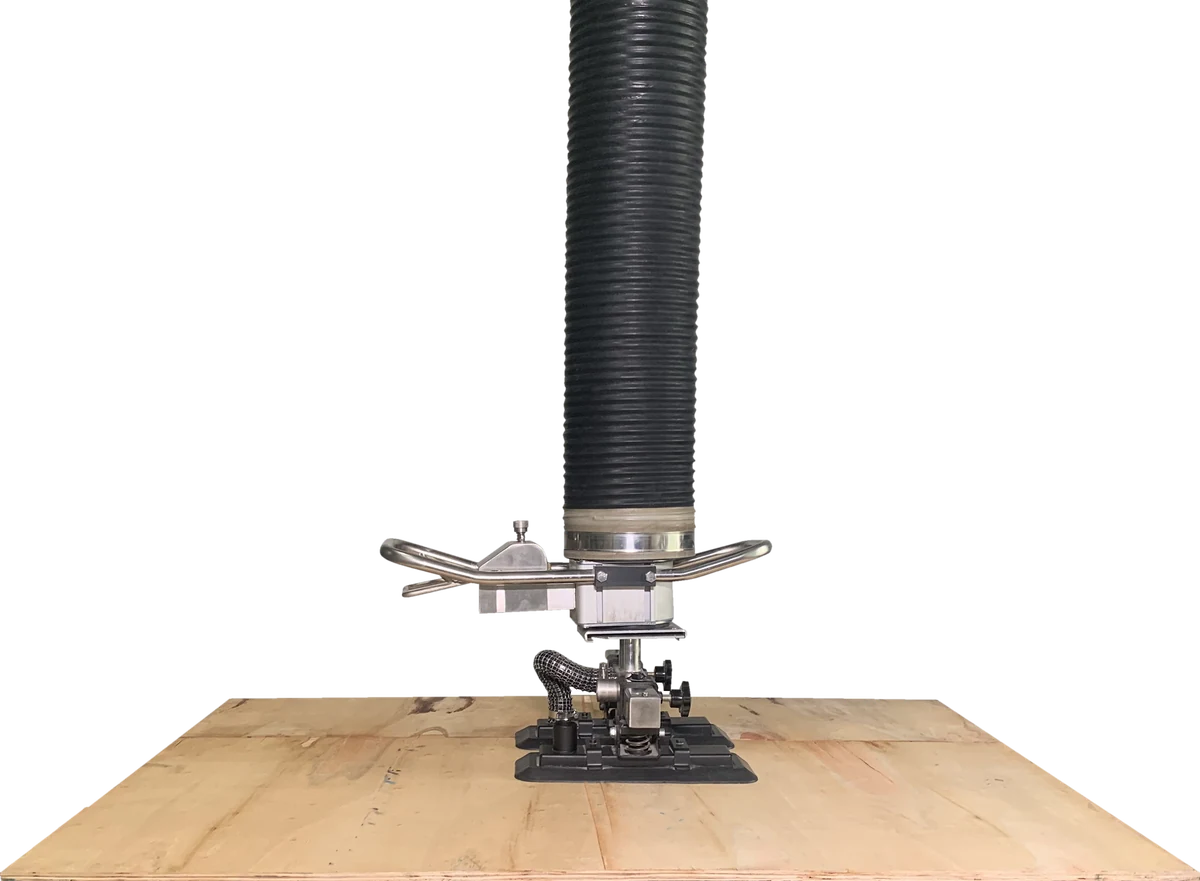
Lift, hold and lower are all worked from the one handle, which on the ESL-SG is stainless steel.
Single-Handle ESL-SG
ESL-SG single-handle vacuum tube lifters
The ESL-SG is the one-hand series of the Cowest vacuum tube lifter range: four models starting at 35 kg, each with a stainless-steel handle and a 1,700 or 2,500 mm lifting height. The operator lifts, holds and lowers from the handle and keeps the other hand free to guide the carton, sack or pail into place. Unlike a hand-held suction cup, it hangs from a jib crane or rail, which carries the weight. To set it beside the two-handle, compact and mobile units, see all vacuum tube lifters.
- Four models, each rated in the specification table
- Stainless-steel handle for one-hand control
- Up to 0.8 m/s lifting speed on all four
- Carton, sack and pail pads listed for the series
The ratings are for airtight loads; a plain carton or a paper sack lifts less, so we lift your samples and the quotation names the load each rating covers.
- Handle:
- stainless steel
- Lifting height:
- 1,700 or 2,500 mm
- Lifting speed:
- up to 0.8 m/s
- Blower power:
- 2.2–3.0 kW
Use cases
Where one-hand operation pays off
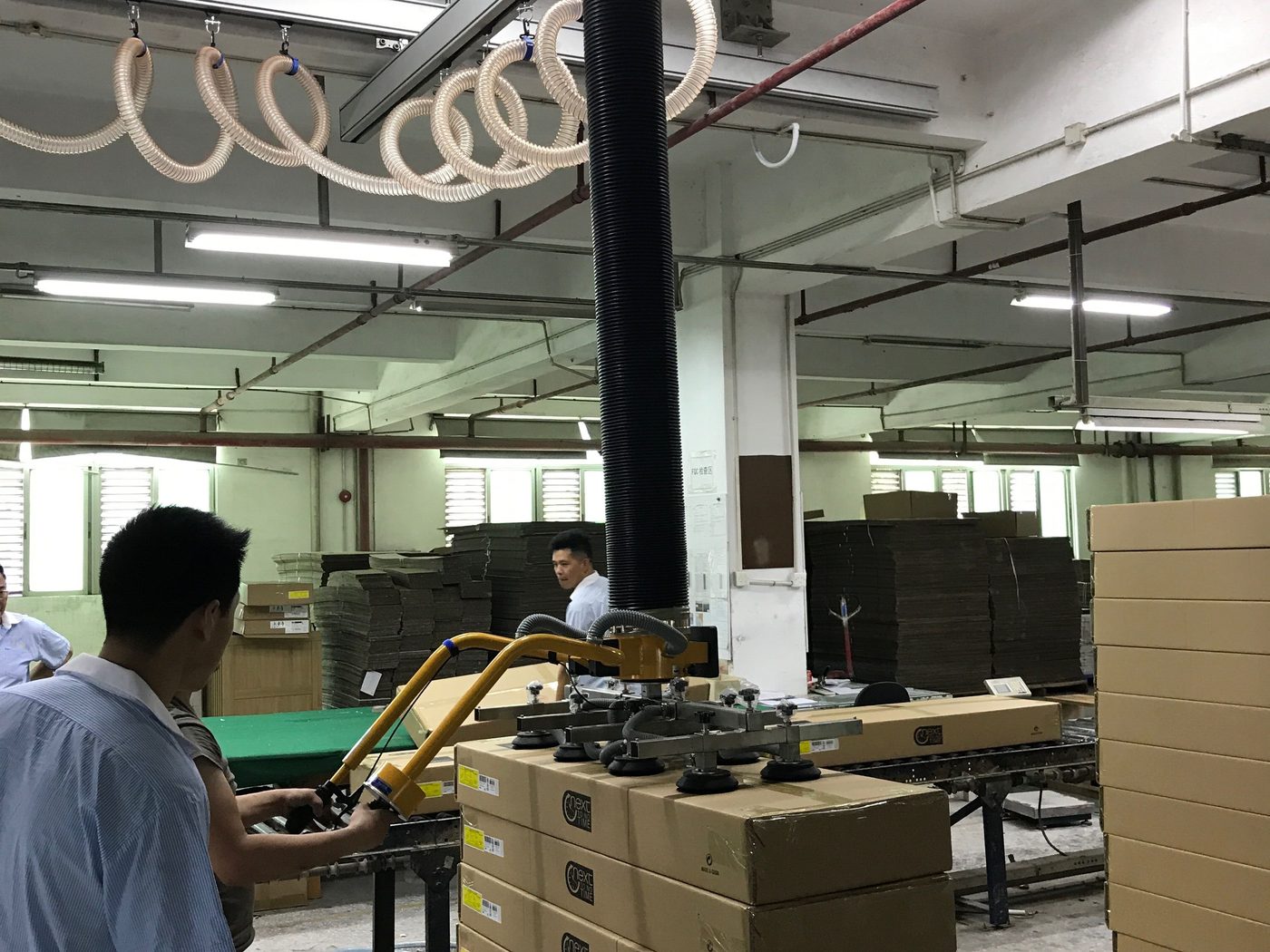
The ESL-SG is built for light loads lifted many times an hour. Across the industry, one-hand units are the usual choice up to about 50 kg at high cycle rates and two-hand units take over above that; within the Cowest vacuum tube lifter range the ESL-SG covers that light, fast end and the two-handle ESL-MD the heavy end.
One-hand units are known for short cycles, and the free hand steadies the load or guides it into place while the handle does the lifting.
-
Carton picking and palletising
Cartons are the ESL-SG's everyday load: any of the four models takes the SFD or HB carton pads, and because plain cartons let some air through, the carton weight each model suits is worked out in the selection table below. Taped and split tops, picking from racking and a worked station layout are covered on the lifting cartons with one hand page.
-
25 kg sacks at a filling line
A 25 kg sack is the typical bag job for this series: film or lined sacks of that weight go on the ESL-SG140/22, unlined paper sacks on the ESL-SG160/30, both with the SUS230×380R sack pad. Palletising layouts and the manual lifting limits in our main markets are covered on the vacuum bag lifter for 25 kg and 50 kg sacks page.
-
Pails and small containers
Pails, cans and small containers lifted by the lid take the HB bellows pad, which follows a slightly uneven lid and is listed for all four models. Choose a model rated above the full container weight; heavier drums go to the two-handle ESL-MD with its round drum pad, as the vacuum drum lifter page explains.
Specifications
ESL-SG models and specifications
Choose the lifting height from the drop between the pick point at the bottom and the place point at the top of your stack, with about 0.2 m added so the load clears the pallet edge or the top layer; the 5-step selection guide shows the method.
| Model | Rated capacity | Lifting height | Blower power | Lifting speed | Power supply |
|---|---|---|---|---|---|
| ESL-SG120/22 | 35 kg | 1,700 or 2,500 mm | 2.2 kW | up to 0.8 m/s | 380 V three-phase |
| ESL-SG140/22 | 45 kg | 1,700 or 2,500 mm | 2.2 kW | up to 0.8 m/s | 380 V three-phase |
| ESL-SG160/30 | 60 kg | 1,700 or 2,500 mm | 3.0 kW | up to 0.8 m/s | 380 V three-phase |
| ESL-SG180/30 | 80 kg per catalogue | 1,700 or 2,500 mm | 3.0 kW | up to 0.8 m/s | 380 V three-phase |
The 80 kg of the ESL-SG180/30 is a catalogue rating above the range most single-handle units reach in the industry, so for loads near it the rating for your load is confirmed in the quotation.
Request a quote
send the load, its weight and surface, the lifts per hour and the pick and place heights.
| Load | Starting model | How it works out |
|---|---|---|
| Plain carton up to about 26 kg | ESL-SG120/22, 35 kg, with an SFD or HB pad | Cartons are semi-porous: three quarters of 35 kg leaves about 26 kg |
| Plain carton up to about 33 kg | ESL-SG140/22, 45 kg | At 75%, 45 kg leaves about 34 kg |
| Plain carton up to about 45 kg | ESL-SG160/30, 60 kg | 75% of 60 kg is about 45 kg, so a carton that heavy is tested first, and a heavy carton held only by its top can tear |
| Plain carton over about 45 kg | The two-handle ESL-MD; the ESL-SG180/30, 80 kg per catalogue, only for occasional lifts and after your cartons are tested | 75% of the 80 kg catalogue rating is 60 kg, yet a carton this heavy is past the roughly 50 kg where one-hand work usually ends, and lifting it by the top alone risks tearing |
| 25 kg PE film sack, or a sack with a PE liner | ESL-SG140/22, 45 kg, SUS230×380R pad | Lined paper counts as semi-porous; even at 75% the model clears 25 kg by about 9 kg |
| 25 kg unlined paper sack | ESL-SG160/30, 60 kg, SUS230×380R pad | Plain paper is planned at half the rating until tested: 30 kg here; the 140/22 comes into question only if your sample test gives clearly more than the 56% it needs to carry 25 kg |
| Pail or small container lifted by its lid | The ESL-SG model rated above its full weight, with an HB bellows pad | A container at or near a model's rating moves up one model; the catalogue gives no separate limit for the bellows pad, so ask us before choosing a model for a heavy pail |
| Airtight load of 45 kg or more, kept clear of the 60 kg rating | ESL-SG160/30, 60 kg | Up to about 50 kg it can run at a fast station; heavier loads suit it only for occasional lifts, and the same load lifted all shift goes to the ESL-MD, the usual choice above about 50 kg |
Each row is a first proposal; your samples, the lift rate and the space at the station can change it before we quote.
Pads for cartons, sacks and pails
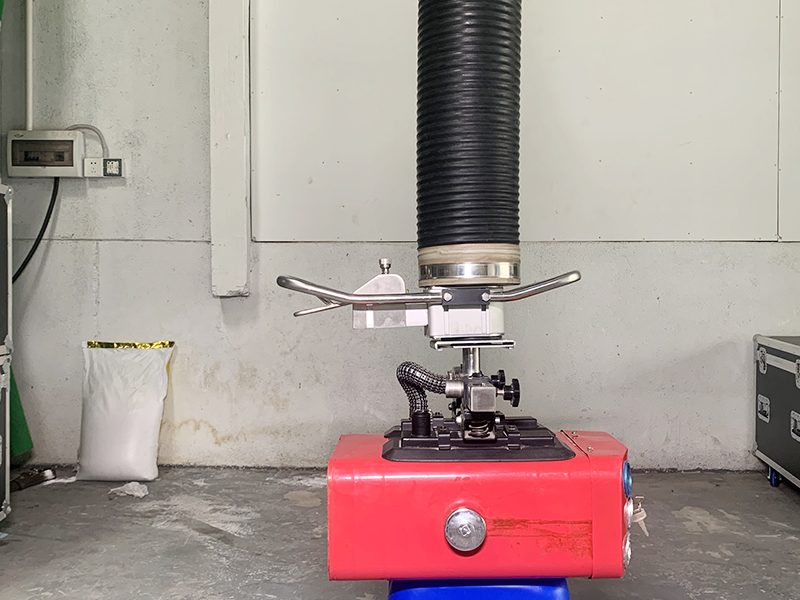
Every load type on this page has a listed pad on each ESL-SG model, so a station that handles cartons in the morning and sacks in the afternoon keeps the same lifter and changes the pad.
| Load | Pad | Models |
|---|---|---|
| Cartons and cases | SFD / HB carton pads | All four ESL-SG models |
| Sacks and bags | SUS190×290R sack pad | ESL-SG120/22 |
| Sacks and bags | SUS230×380R sack pad | ESL-SG140/22, 160/30, 180/30 |
| Pails, cans and small drums | HB bellows pads | All four ESL-SG models |
Features
One hand on the handle
All four models lift at up to 0.8 m/s, so how many lifts a station makes in an hour depends mainly on the walk to the load and the stacking pattern.
How many ESL-SG stations a line needs
Work it out from the hourly rate: items per shift divided by the effective working hours gives the lifts needed per hour, and that divided by a realistic cycle rate gives the number of stations, rounded up.
A worked example with assumed figures: 2,400 sacks in 6.5 effective hours is about 370 lifts an hour. An assumed 12-second cycle is 300 lifts an hour on paper; planned at 70% it gives about 210, so the line needs two stations, while planned at 60%, about 180 an hour, it would need three.
Advertised cycle figures are ideal values; plan on about 60–70% of them.
Safety
Safety at a high-rate station
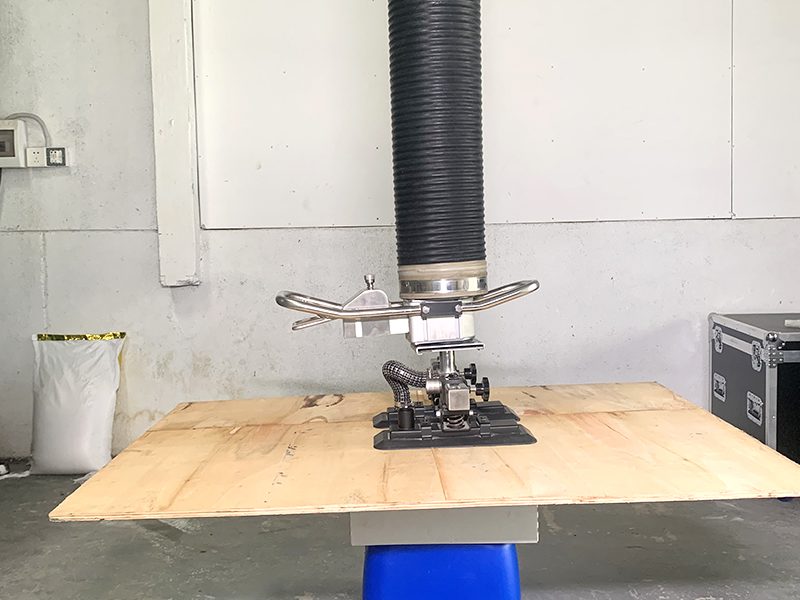
At a station lifting several times a minute, two rules from published safety guidance apply on every lift: keep the load low, ideally below about 1.5 m, and keep everyone out from under it.
The power-failure behaviour of a tube lifter is set out in how a vacuum tube lifter works; the manual for your ESL-SG model is the reference for that unit.
Before the shift
The pre-use check is short: tube and cover, hoses, pad seal, filter, the handle's response and one test lift with a typical load. The full daily and weekly lists, with a printable sheet, are in the maintenance checklist; for your unit, the checks in its manual come first. Pads, seals and filters for a station that runs all shift are ordered from spare parts.
Mounting
Mounting and working area
An ESL-SG station hangs from a pillar jib crane or an aluminium rail, and the class of crane or rail is settled in the proposal from the model's rated load plus everything that hangs from the trolley, the trolley itself included.
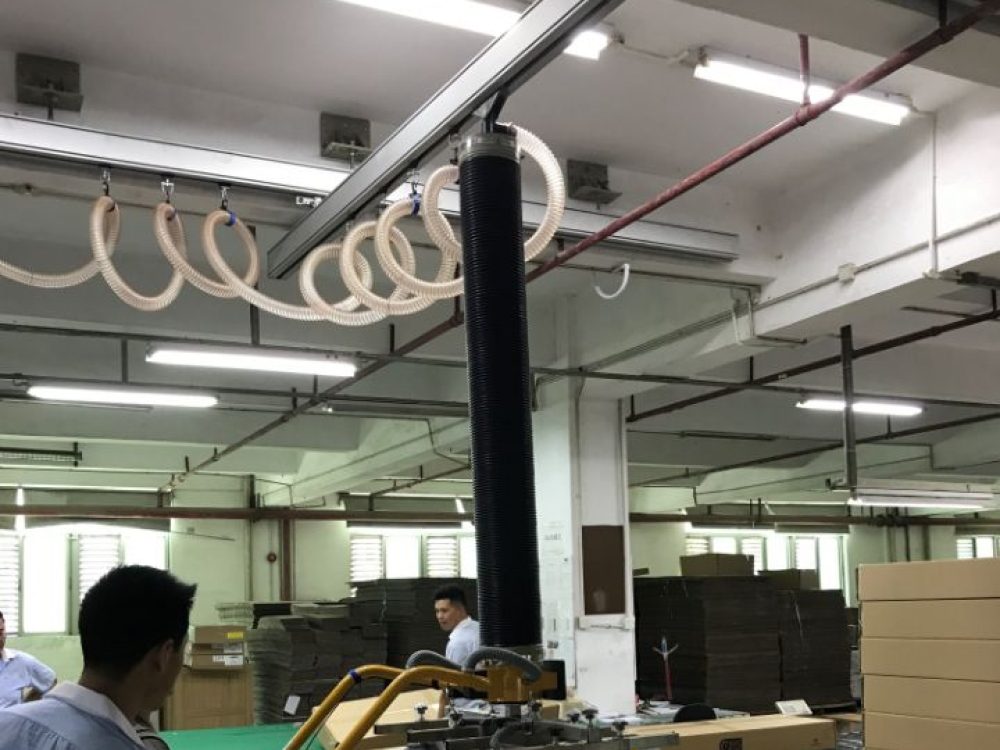
Headroom:
stacking cartons high raises the highest place point, and the clear height for your station is checked on the factory drawing.
Coverage:
mark every pick and place point on the floor plan first, because all of them must lie inside the arm's reach, clear of the dead zone at the column, or under the rail.
Mobile alternative:
where the work moves between stations inside the building, the MD-SG (pushed) or AD-SKG (self-propelled) is a complete battery-powered unit rated 60 kg with a 1,700 mm lifting height, kept stationary while lifting.
One palletising spot: a jib crane
The arm swings over the pallet and the end of the conveyor; WJC cranes come in 125 and 250 kg classes with 2.5–4.0 m arms and 180°, 270° or 360° slewing, sized on the pillar jib crane page.
Picks along a line: a rail
A rail covers a straight run, such as a row of pallets beside a conveyor; AM150 and AM250 profiles come in 6 m lengths, with the details on the aluminium rail page.
Fit check
When not to choose this model
When another series or another tool fits better than the ESL-SG
-
Case
Anything over the 80 kg catalogue rating, or loads of about 50 kg and up, 50 kg sacks included, lifted all shift
Why the ESL-SG is not the answer
Single-handle units in the industry usually stop at about 50–65 kg, and the 80 kg of the ESL-SG180/30 is a catalogue value
What instead
-
Case
A load that has to be stood on its side
Why the ESL-SG is not the answer
The ESL-SG catalogue lists no tilt
What instead
The ESM compact, rated 25 and 35 kg with a 90° tilt, or the ESL-MD with its tilt option; either one is sized on the manufacturer's tilt rating, which sits below the horizontal rating
-
Case
Flour, sugar or solvent areas classed as hazardous zones
Why the ESL-SG is not the answer
There is no explosion-proof ESL-SG
What instead
Nothing in our range, as we do not offer explosion-proof versions; give the zone classification with the enquiry so this is clear before any quotation
-
Case
Uncoated woven, jute or cloth sacks
Why the ESL-SG is not the answer
Often too open to hold on vacuum alone
What instead
A sample test first; where vacuum cannot hold them, the industry usually turns to a mechanical sack gripper
Request a quote
For an ESL-SG proposal, the facts that decide the model and pad are the heaviest load and its surface, the size of its top face, the lifts per hour, and where the picks and places are.
- Cartons: weight range, size of the top face, and whether the top is taped or split
- Sacks: weight, PE film, lined or plain paper, and the sack size
- Pails: full weight and the shape of the lid
- Station: lifts per hour, pick and place heights, clear height, site altitude, indoor or outdoor use, any classified hazardous zone, and voltage and frequency, with 380 V three-phase as standard and others on request
The quotation names the ESL-SG model, the pad for each load it is quoted for and the weight it covers, then the crane or rail; lead time, warranty and payment are stated with them.
Price levels, the trade terms and what each one adds to the figure are compared in the vacuum tube lifter price guide.
Scope
What the ESL-SG does not cover
The series stops at the 80 kg catalogue rating of the ESL-SG180/30 and has no tilt in the catalogue and no explosion-proof version; heavier loads move to the two-handle ESL-MD, and anything over 200 kg is outside our tube lifter range.
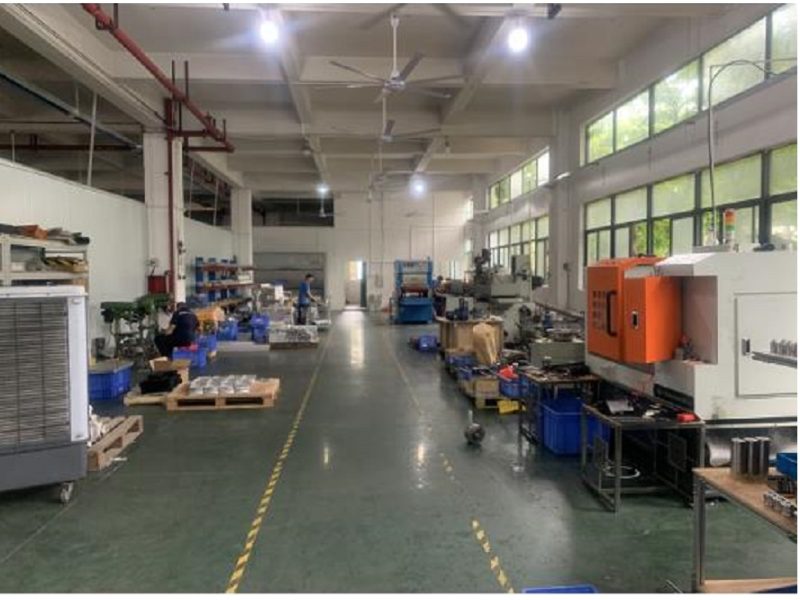
Cowest Machinery designs and manufactures vacuum tube lifters at its factory in Qingyuan, Guangdong, China; CE marked, with Attestation of Conformity No. CE-1629-01-011123 (CGS Test, valid to 2028) available on request.
Tools
Tools and documents for the ESL-SG
-
ESL-SG data sheet (PDF):
print the four ratings, blowers and lifting heights for the station file
-
Lift capacity calculator:
enter the weight of a carton or sack, its porosity class and your site altitude to see roughly what airtight rating it calls for, then hold that against the ESL-SG ratings
-
NIOSH lifting calculator:
check whether picking cartons by hand at your rate is over the recommended weight limit
-
Porous paper and woven sacks:
which sack constructions hold on vacuum and which need a test first
-
Factory and documents:
the Qingyuan factory, and the documents a buyer can request, the CE Attestation of Conformity among them
ESL-SG questions
How much can the ESL-SG lift?
Rated 35, 45 and 60 kg, and 80 kg per catalogue on the ESL-SG180/30, for airtight loads. As an industry estimate, a plain carton is planned at about three quarters of that and an unlined paper sack at about half, the low ends of the usual ranges, until your samples are tested.
Which ESL-SG for 25 kg paper sacks?
Unlined paper starts on the ESL-SG160/30 and sacks with film or a liner on the ESL-SG140/22, both with the SUS230×380R pad.
Is the ESL-SG180/30's rating realistic on one handle?
The 80 kg of the ESL-SG180/30 is a catalogue rating above the roughly 50–65 kg where single-handle units usually stop in the industry. We confirm the rating for your load in the quotation, and heavy loads lifted all shift go to the two-handle ESL-MD.
Can the ESL-SG tilt a load?
No tilt is listed for the ESL-SG. The ESM compact, rated 25 and 35 kg, tilts 90° and rotates 360°, and the ESL-MD offers a tilt option for heavier loads; on either series a tilt job is sized on the manufacturer's tilt rating, which is below the horizontal one.
Which sack pad does the ESL-SG120/22 take?
The smaller SUS190×290R; the other three models take the SUS230×380R.
Can one ESL-SG handle cartons, sacks and pails?
Yes, with a pad change: carton, sack and bellows pads are all listed for the series. Each load still has to sit within what the model holds for that surface.