Manual handling
Mechanical aids for manual handling: eight types and when each fits
Compiled from public standards and manufacturers' published data.
Mechanical aids for manual handling are the equipment that takes the weight, the reach or the repetition out of a lift: from a trolley to a palletising robot. Most manual handling rules ask employers to avoid hazardous manual lifting first, typically with mechanical aids, and only then to assess and reduce the risk that remains. This page compares eight types by load, frequency and height, says what each needs on site, and shows where a vacuum tube lifter belongs in that family. It is written for plant and EHS managers choosing an aid, not for people being lifted.
Why the rules put mechanical aids first
The European directive on manual handling, 90/269/EEC, tells employers to avoid manual handling by organisational measures or appropriate means, in particular mechanical equipment, and to assess and reduce the risk where it cannot be avoided; the United Kingdom's 1992 regulations keep the same three steps. Germany's load handling ordinance names mechanical equipment as the way to avoid manual handling. Outside Europe, several Latin American rules point the same way: Chile's Labour Code allows a man to lift up to 25 kg only where mechanical aids cannot be used, Peru's rule asks employers to prefer mechanical aids above 25 kg for men and 15 kg for women, and Brazil's NR-17 asks for technical aids first. Australia takes another route: its model Code of Practice gives no kilogram figure, works down a hierarchy of control, and counts vacuum or magnet assisted lifters among its example aids; whether the code has legal force depends on the state or territory.
Compliance belongs to the workstation rather than the equipment, and it is shown by the employer's risk assessment, operator training and inspection records. Country-by-country kilogram figures sit on the manual handling weight limits by country page.
Eight types of mechanical aid
| Type | What it does | Typical loads | Strengths | Limits |
|---|---|---|---|---|
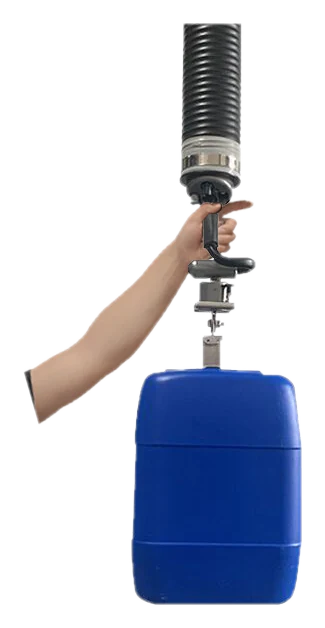
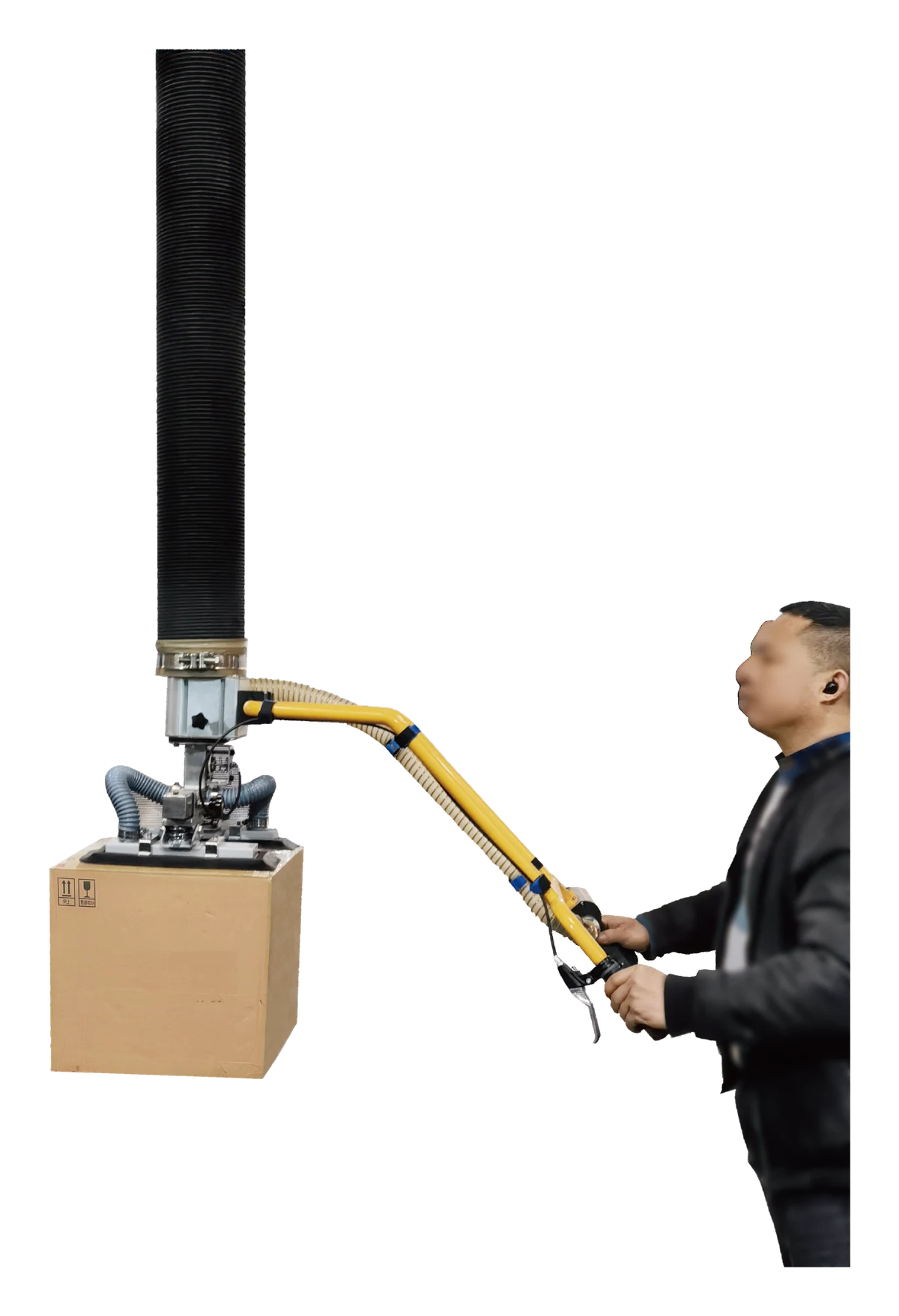
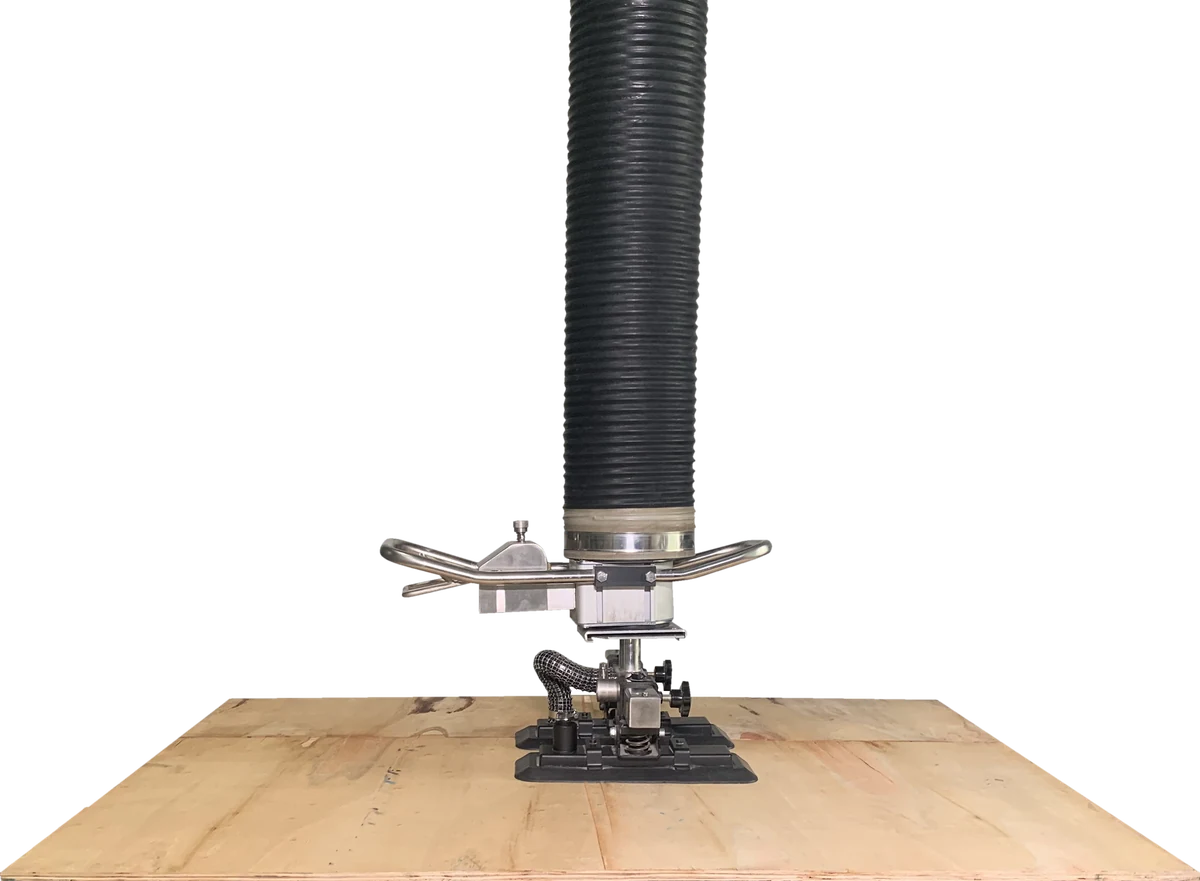
| Vacuum tube lifter | One airflow grips the load on a pad and lifts it by contracting a tube; the operator steers with a handle | About 20–300 kg | Fast, up to about 60 m/min on some units; one unit handles bags, cartons, drums and panels by changing the pad | The tube works vertically only; the load needs a face that seals |
| Vacuum lifting device under a hoist | Suction pads on a beam hung from a hoist or crane | Hundreds of kilograms to over 2 t | Flat, airtight sheets: steel plate, glass, stone | Limited by the hoist speed; medium to high cost |
| Pneumatic balancer | Makes the load weightless on a cable or arm; the operator positions it | Light to medium loads (estimate) | Precise placing at assembly stations | Needs its own end tool |
| Articulated or rigid-arm manipulator | A rigid or jointed arm takes off-centre loads and turns or inserts them | About 5–1,500 kg, one maker's range | Off-centre parts, turning, reaching into machines | Medium to slow; high cost |
| Chain hoist with a clamp or sling | Lifts in two steps: attach, then hoist | Tonnes | Low cost for occasional heavy lifts | Slow; not for frequent lifts |
| Collaborative palletising robot | An arm with a gripper places product without an operator | One maker lists 20–35 kg, gripper included | Steady, unattended | Needs programming and integration; expensive, and the cost rises when the product mix changes often |
| Lift tables and conveyors | Bring the work to waist height or move it horizontally so that nobody carries it | Set by the equipment; not given here | Remove bending and carrying from a task rather than the lift itself | Do not take the weight out of the lift at the pallet |
| Trolleys and forklift attachments | Move the load horizontally or by machine | Set by the equipment; not given here | Simple; move loads without carrying them | Do not help with placing a bag or box on a stack by hand |
The first six rows carry figures from makers' published data and industry estimates; the last two are described in words only; no published figures are cited for them. The lifters in the first row hang from a carrier: a pillar jib crane, a rail system or a mobile column, compared on the lifting systems page. How the first row works is on how a vacuum tube lifter works.
Choosing by load, frequency and height
Three questions sort most stations. First, how heavy: loads up to about 50 kg at several lifts a minute point to a single-handle tube lifter, heavier loads to a two-handle one, loads above about 300 kg to a vacuum lifting device under a hoist or to a manipulator. Second, how often: occasional heavy lifts suit a hoist with a clamp; frequent lifts of mixed products suit a tube lifter; one product at a continuous rate suits a robot. Third, how high and how far: a tube lifter's stroke is typically about 1.3 to 2.7 m, which sets the stack height it can serve, and the carrier sets the floor area.
| Site situation | Usual carrier | Why |
|---|---|---|
| One station, pallet to conveyor, radius up to about 5 m, good floor | Pillar jib crane, 270° | Low investment; slow to medium cycle rates |
| Several stations along a line, high cycle rate | Rail system, monorail or bridge | Large coverage, light to move; higher investment |
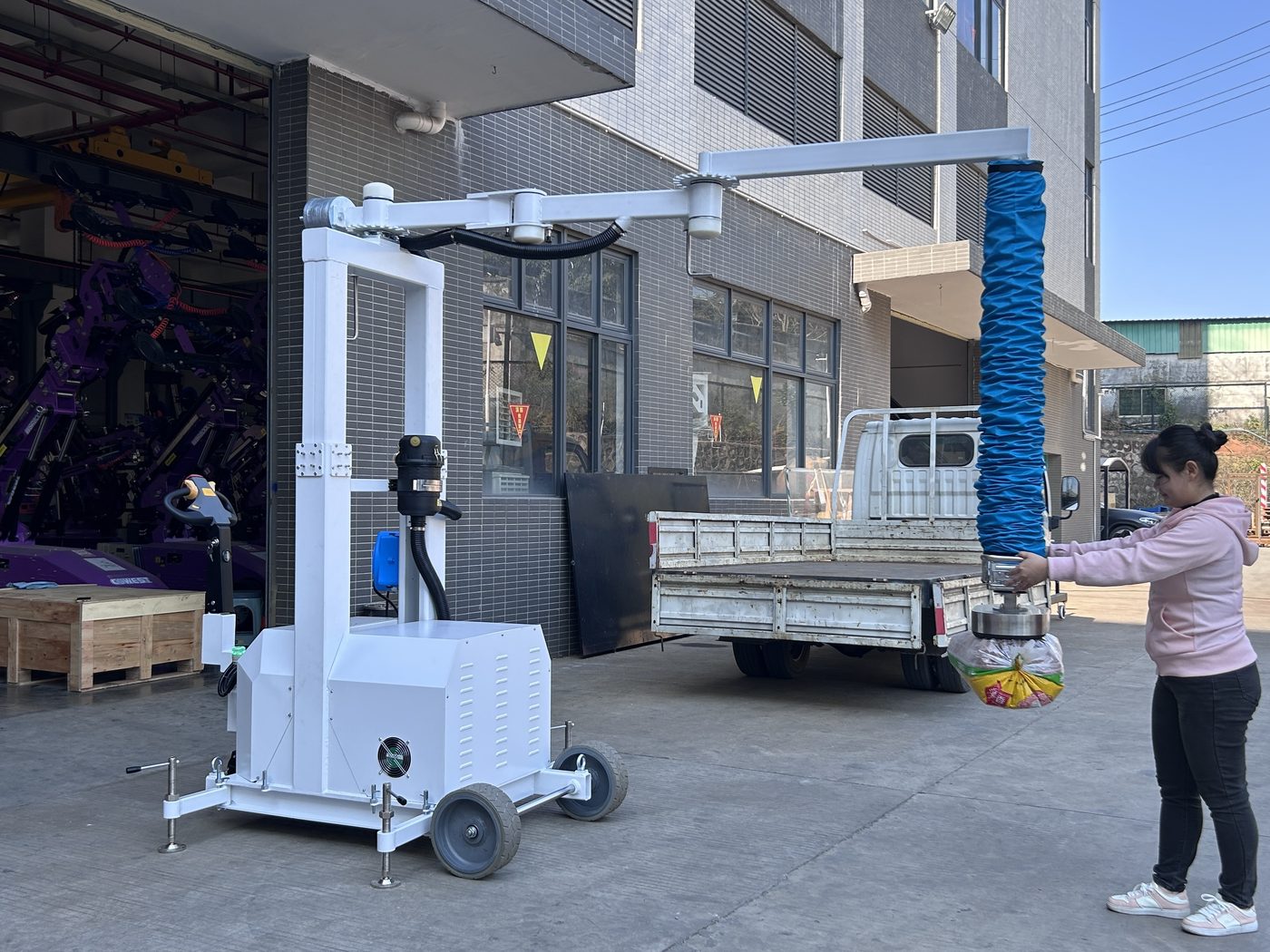
| Rented building, no drilling, or seasonal use | Mobile unit | No floor fixing |
| Roof cannot carry a rail | Free-standing frame supplied locally | Carries its own columns |
Condition: a load that does not seal, such as an unlined woven sack, an open-top tote or a strapped bundle, takes a special pad or a mechanical gripper and a sample test before a vacuum aid is chosen; porous loads lose capacity and are planned at a fraction of the rated value. Next step: how the three routes compare for palletising in particular is on manual palletizing.
What each aid needs on site
| Need | Which aids | What to check |
|---|---|---|
| Floor or foundation | Pillar jib cranes, manipulator columns | Slab thickness, concrete grade, reinforcement, joints and cracks; a foundation block where the slab is thin |
| Roof or steel structure | Rail systems | The structure is checked for the hanging loads, or a free-standing frame is used |
| Clear height | Tube lifters, hoists, balancers | Beams, lights and sprinklers measured; the required height is read from the supplier's drawing |
| Power | All powered aids | Plant supply (voltage, phase, frequency) and the local plug type |
| Compressed air | Balancers, ejector-type vacuum generators | Whether air is available and at what pressure |
| Trained operators | All lifting aids | Only trained people operate the aid; the training is recorded |
| Periodic inspection | All lifting aids | United Kingdom: thorough examination at least every 6 or 12 months under LOLER, or under a written scheme of examination; United States: for vacuum lifting devices, ASME B30.20 sets frequent and periodic inspections by service class, and your inspector confirms which standard covers each aid; one maker's manual asks for weekly operator checks, quarterly in-house checks and a yearly service |
Next step: the site checklist we use for a lifter and its crane is on the lifting systems page.
Where a vacuum tube lifter fits
A tube lifter earns its place where lifts are frequent, loads are mixed and under about 300 kg, and the load has a surface to seal on: one vacuum source grips and lifts, so there is no hook, sling or chain, and changing the pad changes the product. Its limits are as clear: vertical lifting only, limited tilting, no long holding under vacuum, blower noise and heat, and a stroke that needs headroom.
Our own range covers 25 to 200 kg in four series: single-handle ESL-SG, two-handle ESL-MD and compact ESM, carried by WJC pillar jib cranes or AM aluminium rails, and battery-powered mobile units on their own column. It stops at 200 kg and has no explosion-protected build. Next step: the series are compared on the vacuum tube lifters page.
Common mistakes
- Choosing the crane by the lifter's rated capacity alone: the crane must also carry the weight of the lifter, tube, pad and trolley
- Drilling into a floor that looks thick: thickness, grade and reinforcement are checked first, and joints and cracks avoided
- Sizing a vacuum aid for a porous load at its rated capacity: paper sacks and open cartons are planned at a fraction of it and tested with samples
- Fitting stops to limit where the lifter can travel: makers forbid it unless both suppliers agree in writing
- Buying the aid before the risk assessment: the assessment decides which aid, and the aid does not replace the assessment
FAQ
Does buying a mechanical aid make the workstation compliant?
No. Compliance is shown by what the employer does around the aid: assessing the task, training the operators, arranging the inspections local rules require, and applying the limits for pregnant and young workers to any manual work that is left.
Who trains the operators?
Only trained people should operate the aid. Who gives the first training for your installation, and in what form, is agreed in the quotation.
How often must a lifting aid be inspected?
It depends on the country and the aid: in the United Kingdom, a thorough examination at least every 6 or 12 months under LOLER, or under a written scheme of examination; in the United States, ASME B30.20 sets frequent and periodic inspections for vacuum lifting devices by how hard they are used, and your inspector confirms which standard covers each aid; on top of that, follow the maker's manual, which for one maker means weekly operator checks, quarterly in-house checks and a yearly service.
tell us the load, the lifts per hour and the heights, and we say whether a tube lifter is the right aid or not.
Scope
What this page does not cover
Patient and people handling, construction and earth-moving machinery, and rental; glass and stone lifters and explosion-protected versions are outside this site's range.
Cowest Machinery designs and manufactures vacuum tube lifters at its factory in Qingyuan, Guangdong, China.