How it works
How a vacuum tube lifter works
Compiled from public standards and manufacturers' published data.
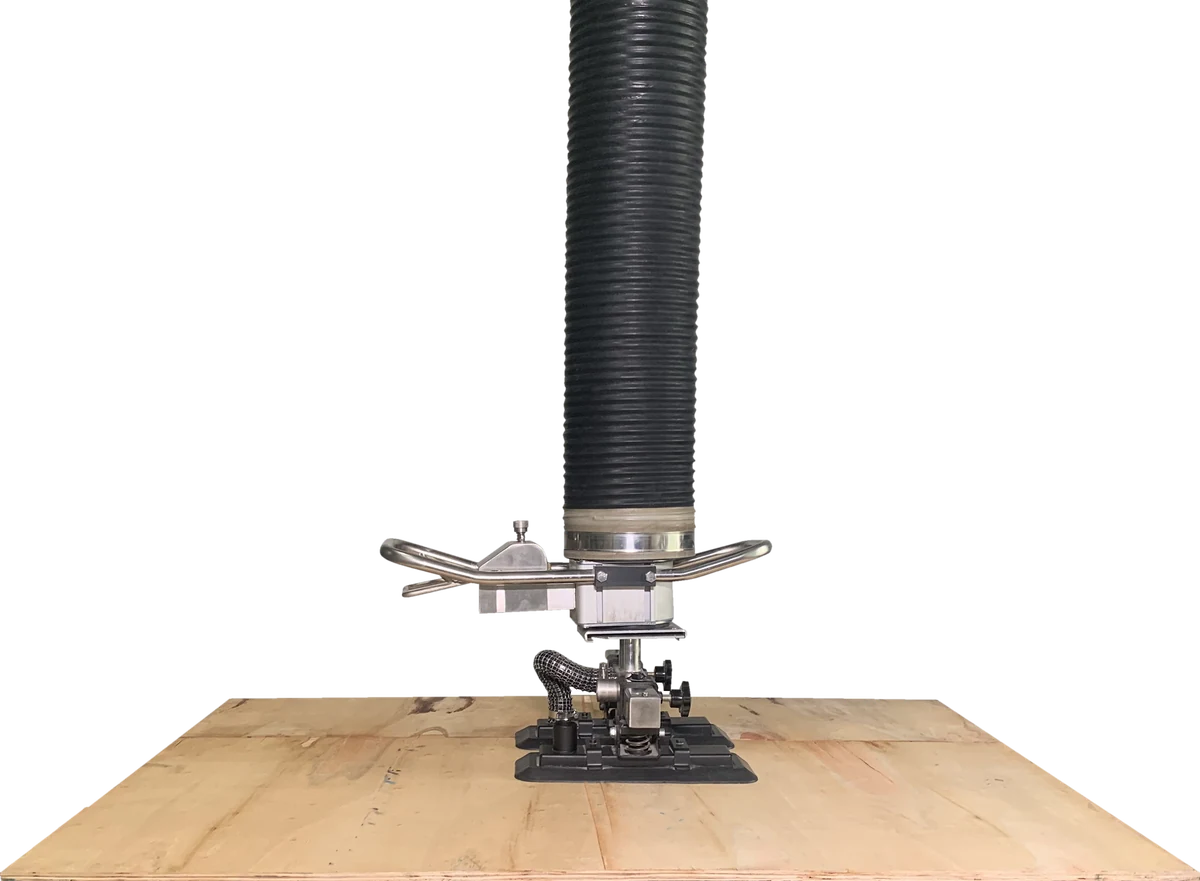
A vacuum tube lifter is an industrial lifting aid for sacks, cartons, drums and panels; it is not the pneumatic home elevator that is also sold under the name vacuum lift. This page explains the principle, the parts, the three kinds of vacuum generator, the safety functions and what happens when the power fails, and compares the tube lifter with other handling methods. It applies to any maker's tube lifter; our own vacuum tube lifter range is used for the examples.
The principle in one paragraph
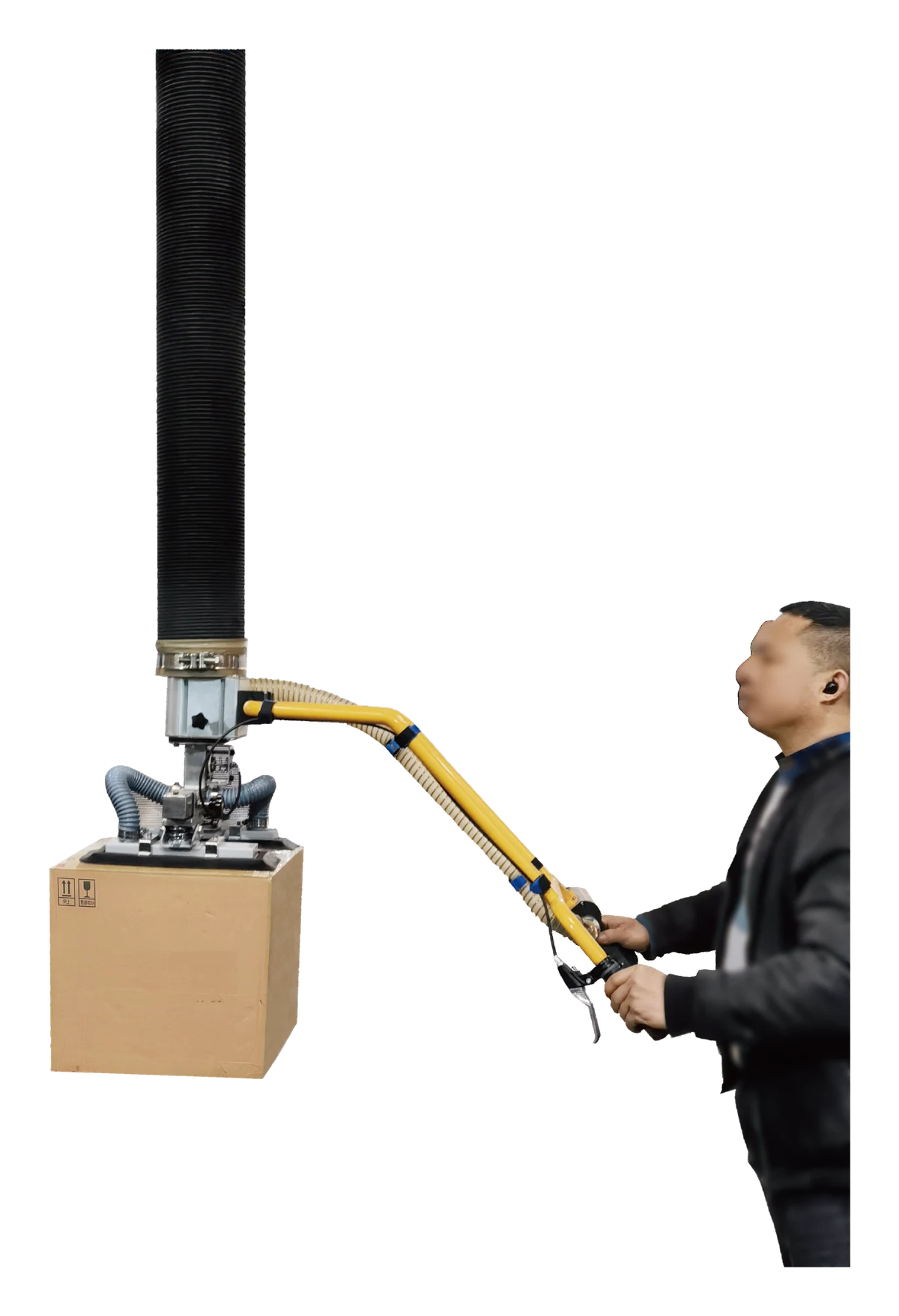
A vacuum tube lifter is a lifting aid hung from a jib crane or rail: a vacuum generator keeps drawing air out of the system; once the suction pad seals on the load, the low pressure holds the load on the pad and makes the lifting tube contract, which raises the load; the operator controls up, down and hold by letting more or less air into the system through the handle. One airflow does two jobs, gripping and lifting, which is why there is no hook, sling or chain.
Step by step: lower, grip, lift, hold, release
- 1. Start: the vacuum generator runs continuously and draws air out of the system
- 2. Lower and seat: with the handle in the lowering position, letting in more air, the pad is set down on the load and seals
- 3. Grip: pressure inside the system falls below atmospheric and the pressure difference presses the load against the pad
- 4. Lift: closing the handle admits less air, vacuum in the tube rises, atmospheric pressure acts on the tube's cross-section and the tube contracts, raising the load
- 5. Hold and lower: the handle adjusts the air admitted until the pull of the tube balances the load, which holds it; more air lets it down
- 6. Release: pressing the handle fully admits atmospheric air, the vacuum collapses and the load is released
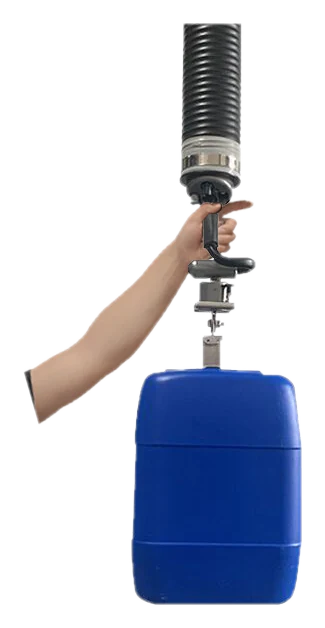
Handles differ: single-handle push-button types, two-handle wrap-around grips and twist grips that work like a throttle; all of them control the lifter by letting more or less air into the system.
The parts of the system
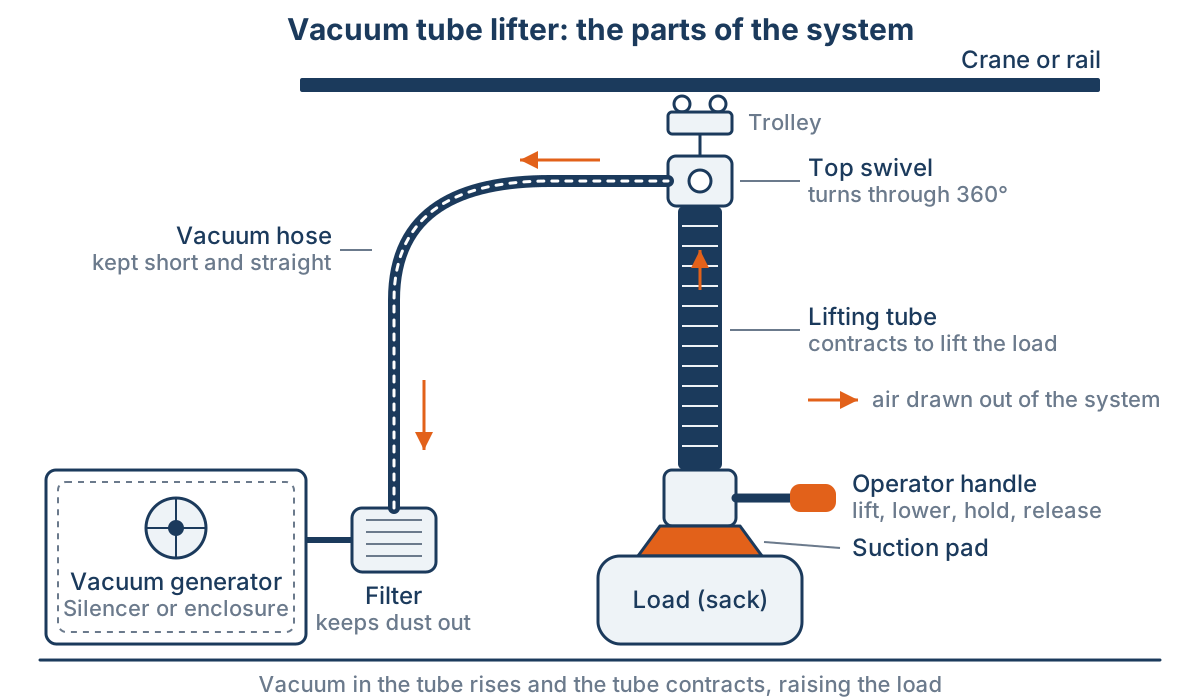
| Part | What it does | Worth knowing |
|---|---|---|
| Vacuum generator | Draws air out continuously | Side-channel blower, vacuum pump or compressed-air ejector; see below |
| Filter | Keeps dust out of the generator | Essential with sacks of powder; some makers specify weekly cleaning |
| Vacuum hose | Connects generator and tube | Kept short and straight; makers limit total length |
| Lifting tube | Contracts to lift the load | Wire-reinforced fabric or rubber hose with a wear cover against sharp edges |
| Operator handle | Controls lift, lower, hold and release | Single-handle button type, two-handle wrap-around, twist grips, extended handles |
| Suction pad or tool | Seals against the load | Round, sack, carton, double, four-pad and long pads; mechanical grippers can be fitted |
| Top swivel | Lets the tube turn through 360° | Usually houses the safety non-return valve |
| Quick-change coupling | Changes pads without tools | On some makes, colour codes prevent mismatching pad and tube sizes |
| Silencer or enclosure | Lowers exhaust and blower noise | An enclosure makes the blower much quieter; the noise figure for a given model comes from the maker's measurement |
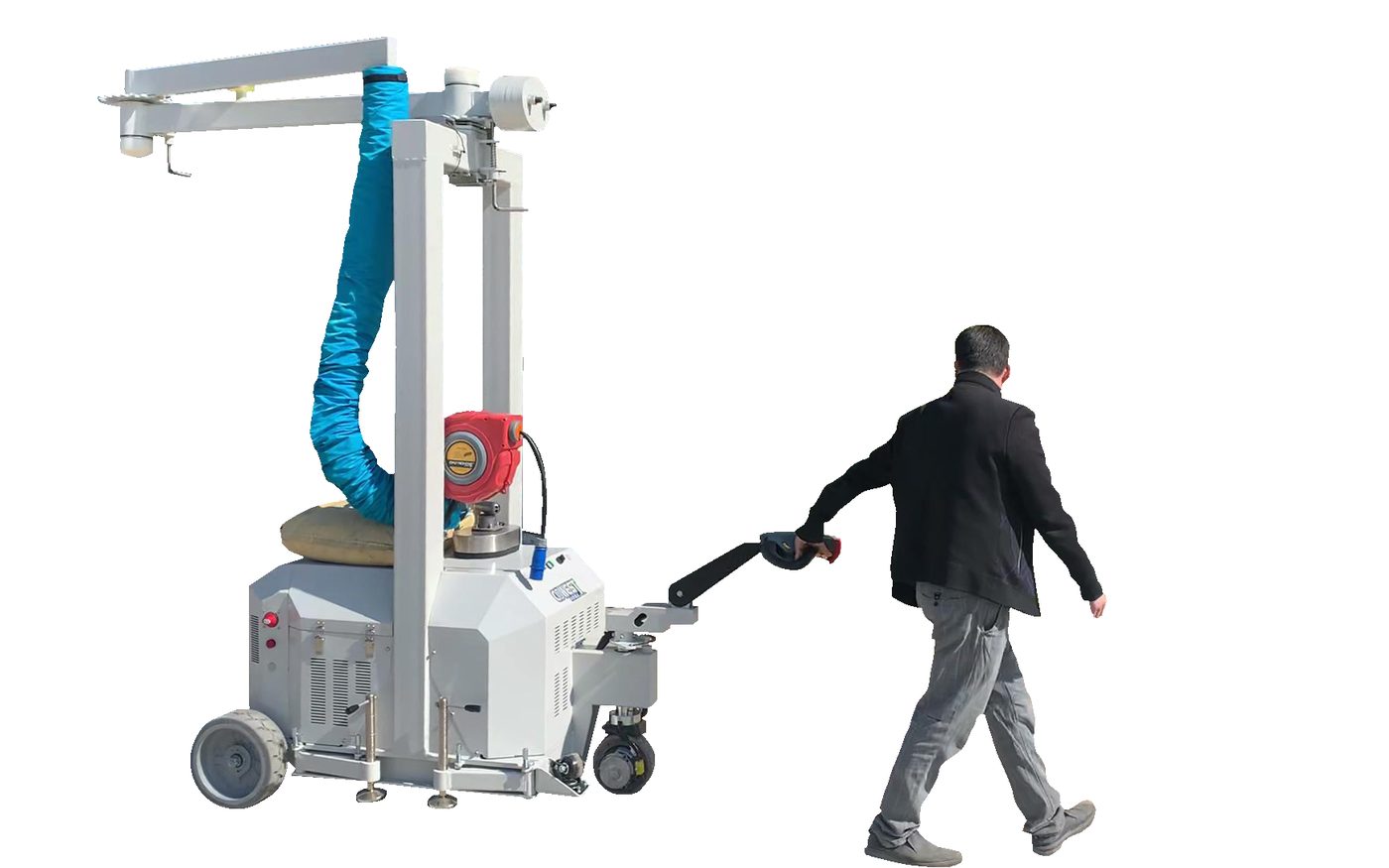
| Crane or rail | Carries the lifter horizontally | Pillar or wall jib crane, aluminium rail, or a mobile column |
On our range the tubes, handles and pads differ by series: single-handle ESL-SG, two-handle ESL-MD, compact ESM and mobile units; the lifting systems page covers the cranes.
Blower, pump or ejector
| Type | Strengths | Watch out for | Typical use |
|---|---|---|---|
| Side-channel blower | High airflow and enough vacuum; quiet in an enclosure; robust | Cooled by the airflow through it, so holding a load still for a long time can overheat it | Common on tube lifters; our ESL series uses 2.2–5.0 kW blowers |
| Vacuum pump (rotary vane is a common type) | Rotary vane pumps: higher vacuum, not dependent on airflow for cooling, quiet in an enclosure | Costs more than a blower; in a rotary vane pump the vanes are wear parts | Light single-handle units; our compact ESM is catalogued with a 40 or 60 m³/h vacuum pump, its type stated in the quotation |
| Compressed-air ejector | Low investment, no heat, no moving parts, quiet, small; suits explosion-protected designs | Uses compressed air continuously, so running cost is high | Plants with compressed air or explosion-protected designs; our catalogue lists blower and pump versions only, and we do not offer explosion-proof versions |
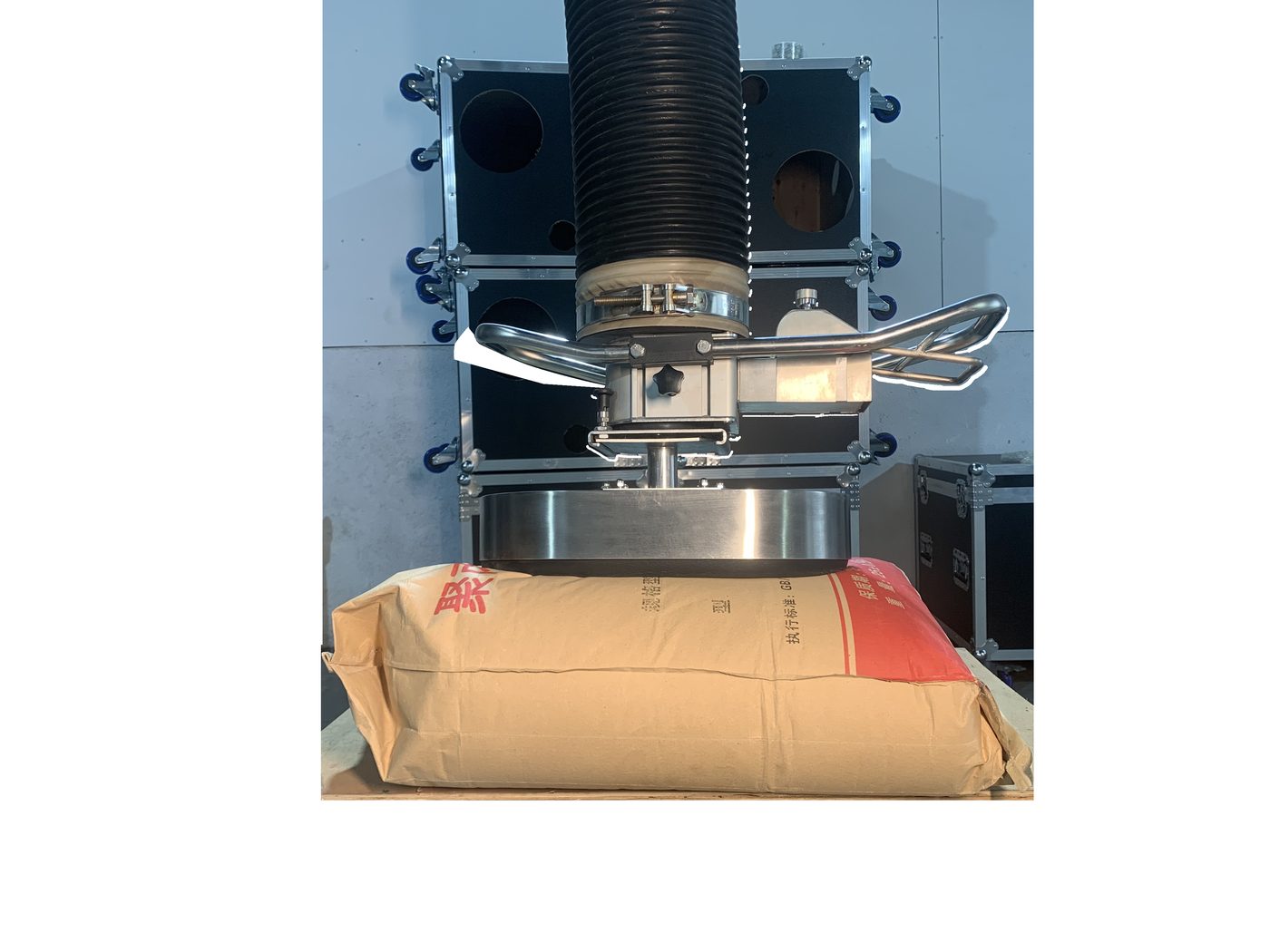
Which one matters most for porous loads: airflow. A generator with high flow keeps the vacuum up while air leaks through a paper sack; a high-vacuum, low-flow generator loses capacity fast on the same sack. That is why the sizing method starts from the load's porosity. See how to choose a vacuum lifter.
Safety functions
| Function | What it does |
|---|---|
| Non-return valve in the top swivel | Closes if the power or generator fails and keeps the vacuum so the load lowers under control |
| Pad area at least twice the tube cross-section | At the same vacuum, the holding force exceeds the lifting force |
| Safety factor | Some makers state a safety factor of at least 2.5 when the pad grips a horizontal face, and one states at least 4 when it grips a vertical face |
| Release protection | The handle must be pressed fully, or both hands used, before the load is released; some units release only when the load is standing |
| Protection valve with hooks and mechanical tools | Vents the tube at once if the load slips, so the tube cannot snap upward |
| Wear cover | Protects the tube from sharp loads |
| Vacuum gauge or indicator | Some makes fit a vacuum gauge at the handle so the operator can see the vacuum is adequate; some mobile units add lights and a sound signal |
| Filter clogging monitor | Optional on some units |
| Colour coding | The pad must match the tube size on every lifter; some makes colour-code pads and tubes to prevent mix-ups |
| Speed limiter | On some makes, a valve on the filter reduces speed for new operators or light loads |
Condition: which of these functions a model has depends on the make and model; ask the supplier to confirm them for the model quoted, and for our range we confirm them in the quotation. The standards behind these functions are summarised on EN 13155 and ASME B30.20.
What happens when the power fails
On most tube lifters, a non-return valve in the top swivel closes when the power or the generator fails and slows the loss of vacuum; the load comes down slowly and under control to the ground rather than dropping, and porous loads, which leak faster, typically come down faster. The operator steps back and keeps clear; nobody stands under a suspended load, powered or not.
Why it matters: a tube lifter is not a storage device. It cannot hold a load up indefinitely without power, and holding a load still for long with power on can overheat a blower. Ask us to confirm the power-failure behaviour of the model in your quotation.
Tube lifter vs other handling methods
| Method | Typical capacity | Speed | Flexibility | Relative cost | Suited to |
|---|---|---|---|---|---|
| Vacuum tube lifter | About 20–300 kg | Fast; up to about 60 m/min on some units | High: change the pad, change the load; tube works vertically only | Low to medium | Frequent, repetitive lifting of cartons, sacks, panels and drums |
| Vacuum lifting device under a hoist | Hundreds of kilograms to over 2 t | Limited by the hoist, slower | Medium: flat, airtight sheets | Medium to high | Steel plate, glass, stone |
| Pneumatic balancer | Light to medium loads (estimate) | Medium; precise placing | Needs its own end tool | Medium | Assembly stations |
| Articulated or rigid-arm manipulator | About 5–1,500 kg | Medium to slow | Takes off-centre loads, turns and reaches into machines | High | Off-centre parts, turning, inserting |
| Chain hoist with clamp | Tonnes | Slow, two-step | Low | Low | Occasional heavy lifts |
| Collaborative palletising robot | About 20–35 kg payload, gripper weight included, depending on model and mounting (one maker's models) | Steady, unattended | Low to medium; programming and integration | High | One product, end-of-line palletising |
The wider family of aids, including lift tables and trolleys, is compared on mechanical aids compared.
Strengths and limits
Strengths: one vacuum source grips and lifts, so there is no hook, sling or chain; fast enough for high-frequency work, so it cuts the repetitive manual lifting that leads to strain injuries and sick leave; one lifter handles cartons, sacks, drums and panels with a change of pad; simple to maintain, mainly filters and wear parts.
Limits: the load needs a surface that seals, and porous, slotted, open or strapped loads need special pads and give less capacity; about 300 kg is the practical ceiling before vacuum lifting devices or manipulators take over; the tube works vertically only, so off-centre loads and reaching into machines are not its job; tilting is limited; a load should not be held suspended for long; blowers make noise and heat; the stroke of about 1.3–2.7 m needs headroom.
Next step: if your load is a sack, carton, drum or panel and the lifts are frequent, the how to choose a vacuum lifter guide takes you through sizing; or Get a selection proposal directly.