Selection guide
How to choose a vacuum tube lifter: load, task, environment, site, configuration
Compiled from public standards and manufacturers' published data.
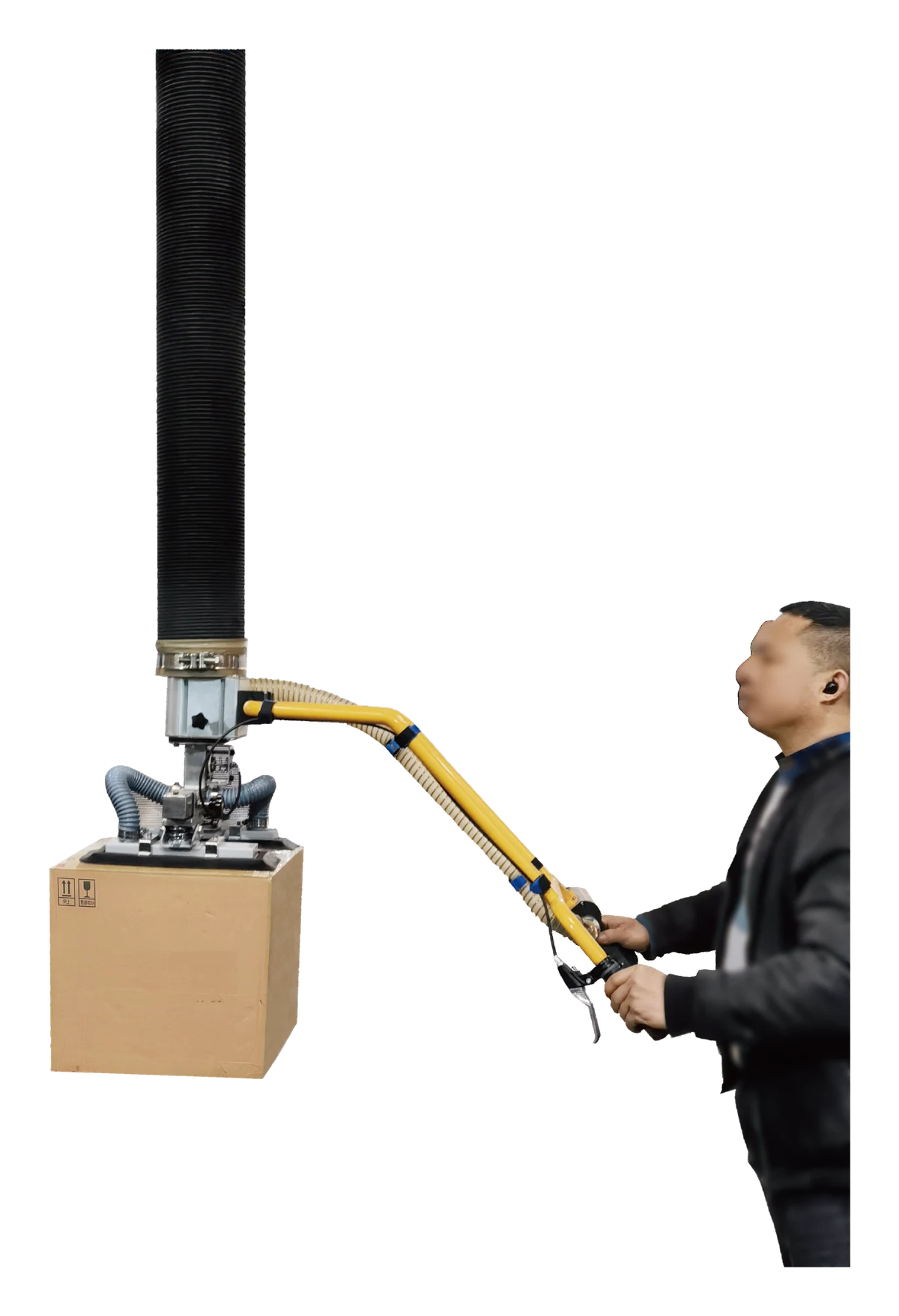
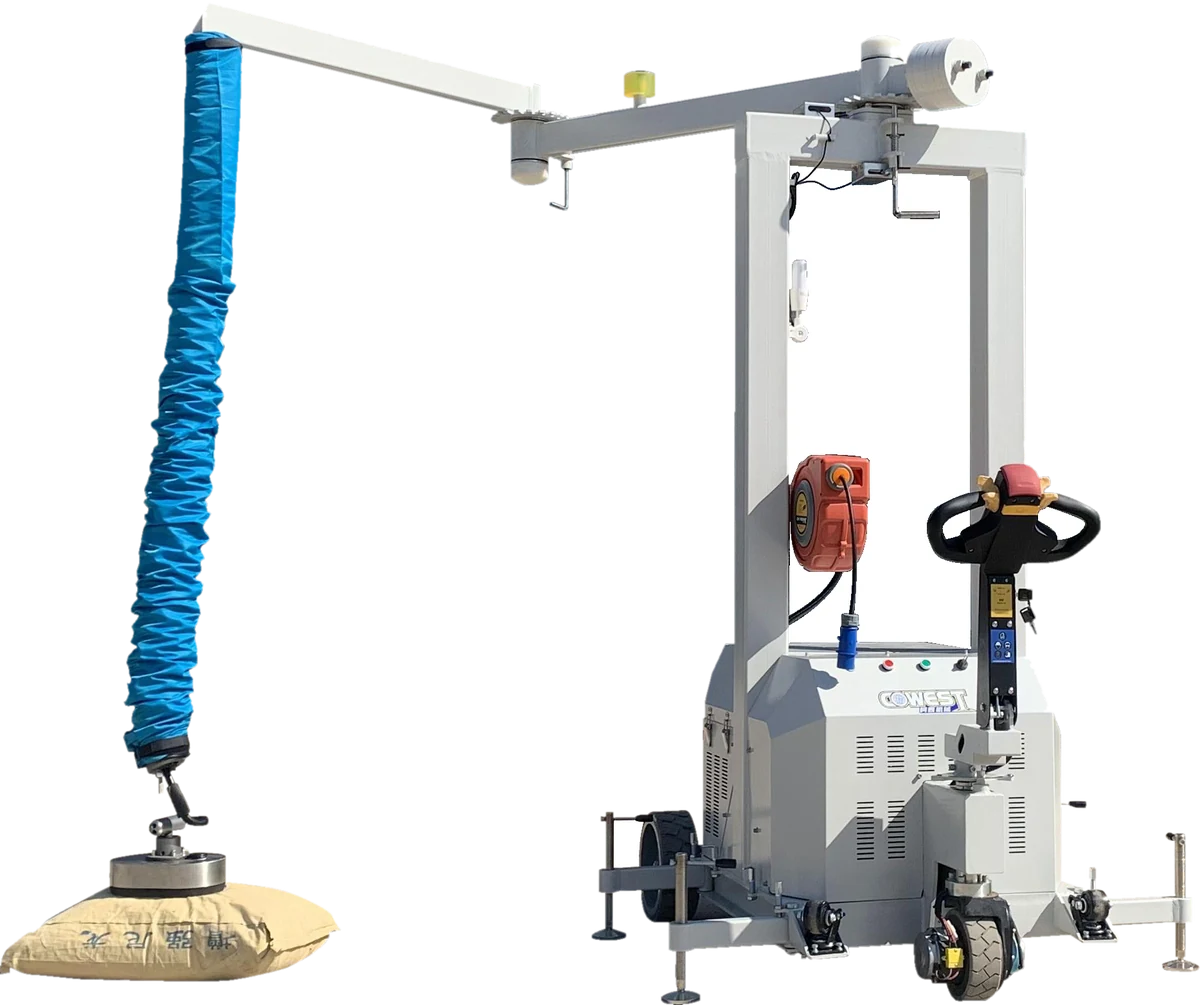
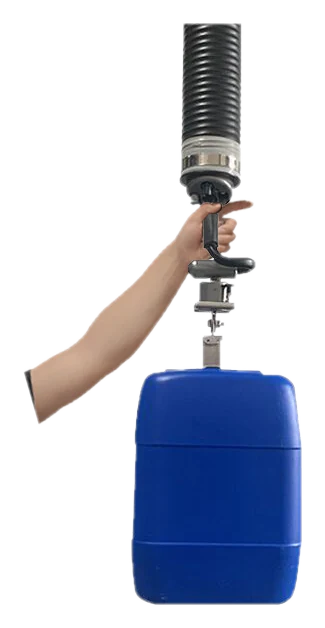
Choosing a vacuum tube lifter comes down to five questions asked in order: what the load is and how porous it is, what the task demands in height, cycle and tilting, what the environment adds in dust, hygiene or explosion risk, what the site allows in headroom, radius and power, and finally which tube, vacuum source, pad and crane make up the configuration. This guide is about crane-mounted tube lifters, the kind used for sacks, cartons and drums; it is not about hand-held suction cups. It applies to any brand; where it helps, it points to our own vacuum tube lifter range.
Step 1 – Load
Start with the heaviest load, not the average; the tube is sized on the maximum weight plus derating. Then write down the dimensions and the flat face the pad can sit on, the packaging material, the surface condition, how full the sack or box is, its temperature and whether the contents can shift.
| Parameter | Record | Why it matters |
|---|---|---|
| Weight | Maximum, and the range from lightest to heaviest | The tube is sized on the maximum plus derating |
| Dimensions and shape | L×W×H and the size of the flat face available | The pad must sit fully inside the face |
| Material and packaging | Multi-wall paper, PE film, woven PP coated or uncoated, jute, corrugated carton, steel or plastic drum, panel | Decides porosity and pad type |
| Porosity | PE liner or lamination? Can you send samples? | Porous loads are derated noticeably |
| Surface | Dust, oil, moisture, stretch film, embossing, print | Loose material can break the seal and drop the load |
| Fill level | Full or slack; is the face flat? | Slack sacks are drawn into the pad; a support mesh is needed |
| Temperature | Surface temperature; frozen? | Seal material choice |
| Fragility and centre of gravity | Fragile? Do the contents move? | Number and position of pads |
| Class | Typical loads | Usable capacity (share of rated) |
|---|---|---|
| Airtight | PE film bags, plastic drums, steel sheet, stretch-wrapped goods | 100% |
| Semi-porous | Plain corrugated cartons, paper sacks with PE liner, laminated woven bags | 75–90% |
| Porous | Unlined multi-wall paper sacks, chipboard | 50–80% |
| Highly porous | Uncoated woven bags, jute, cloth | Often not on vacuum alone |
Next step: the load types we handle page turns these classes into a recommended series and pad for sacks, cartons and drums.
Step 2 – Task
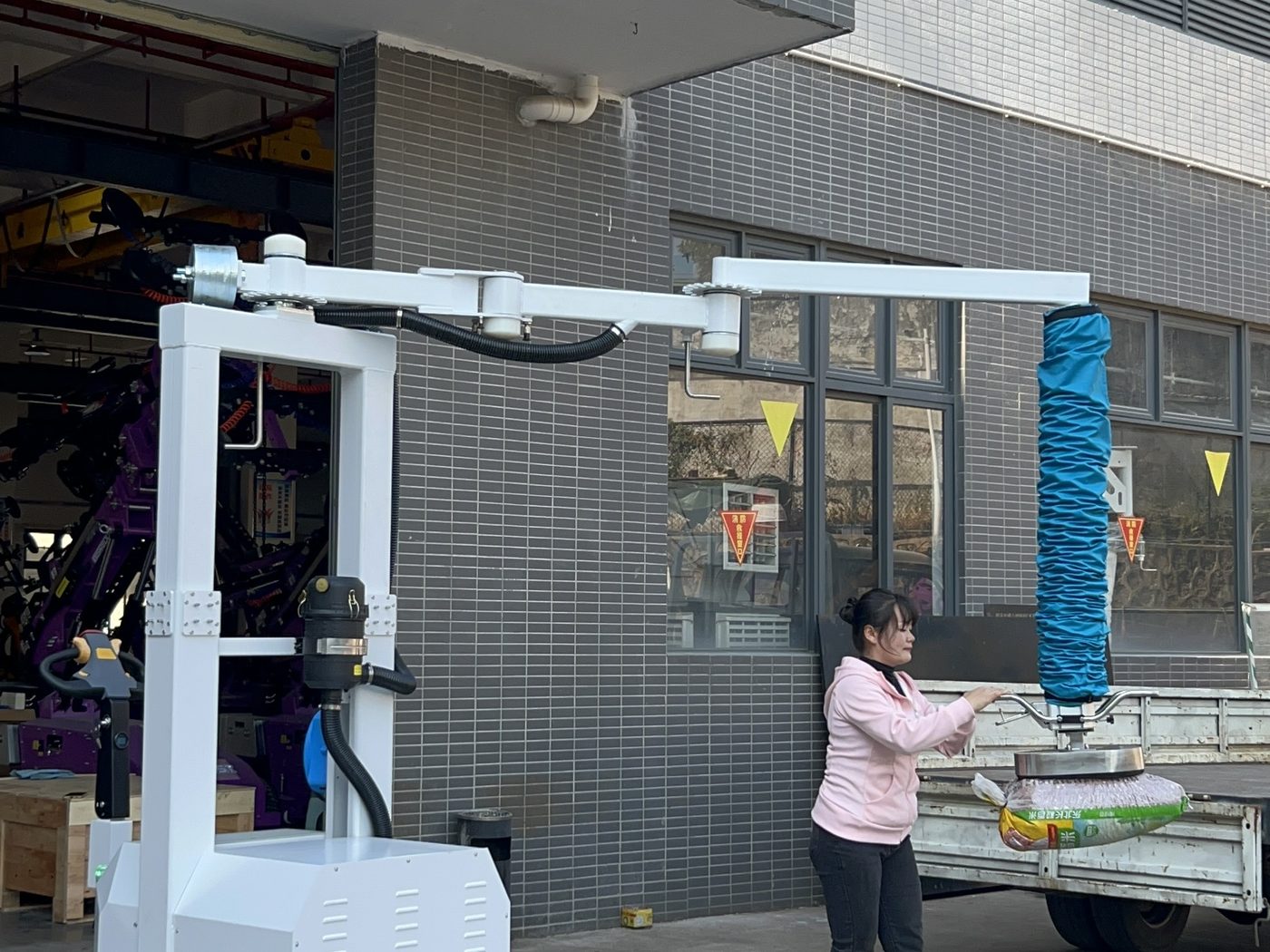
The task sets the stroke, the handle type and the tilt requirement. Record the pick and place points and their heights, the maximum stacking height, lifts per hour and shifts per day, whether the load is picked from the top or the side, and whether it must be rotated or tilted.
Stroke: the required stroke is the highest place point minus the lowest pick point plus about 0.2 m to clear obstacles. Cycle: for sacks, short-distance palletising commonly runs at a few lifts a minute, with the path length deciding the real rate. Tilt: side picking is a tilting job, and tilt ratings are lower than horizontal ratings, commonly by 15–35%. Handle: frequent lifts up to about 50 kg point to a single-handle unit; heavier loads and large panels point to a two-handle unit.
Rule of thumb: light and frequent, one hand; heavy or large, two hands. On our range that is the ESL-SG single-handle series for 35–80 kg (80 kg per catalogue) and the ESL-MD two-handle series for 45–200 kg; above about 50 kg the two-handle ESL-MD is the usual choice. Catalogue ratings are for airtight loads; porous loads are tested with samples.
Step 3 – Environment
Any one of dust, food hygiene, washdown, cold store, outdoor use, cleanroom, corrosion or a classified explosive atmosphere changes the configuration, and some rule out a standard unit altogether.
| Factor | Consequence |
|---|---|
| Dust | Larger dust filter, filter cloth in the pad, weekly filter checks |
| Food hygiene | Polished stainless steel and food-contact plastics with declarations |
| Washdown | Hygienic versions with removable control units; protection rating confirmed per unit |
| Cold store or outdoor | Standard units are specified for indoor use within the manufacturer's temperature range; written confirmation needed |
| Cleanroom | Cleanroom versions exist; class confirmed per unit |
| Corrosion | Acid-resistant stainless versions for chemical, food and pharma |
| Explosive atmosphere | Zone classification is the employer's responsibility. Under the EU ATEX scheme, dust Zones 20, 21 and 22 need equipment of at least category 1D, 2D and 3D; the area around a bag-tipping station without dust extraction is usually Zone 21, and with extraction it can be reduced to Zone 22; other markets use their own schemes; flour is a combustible dust |
Standard units, including ours, are not for explosive atmospheres; a plant that handles flour, sugar, starch or chemical powders must state the zone before anyone quotes, and a supplier without valid Ex certification should decline the job.
Next step: in the send us your answers form, the environment questions are the ones that decide whether we can quote at all.
Step 4 – Site
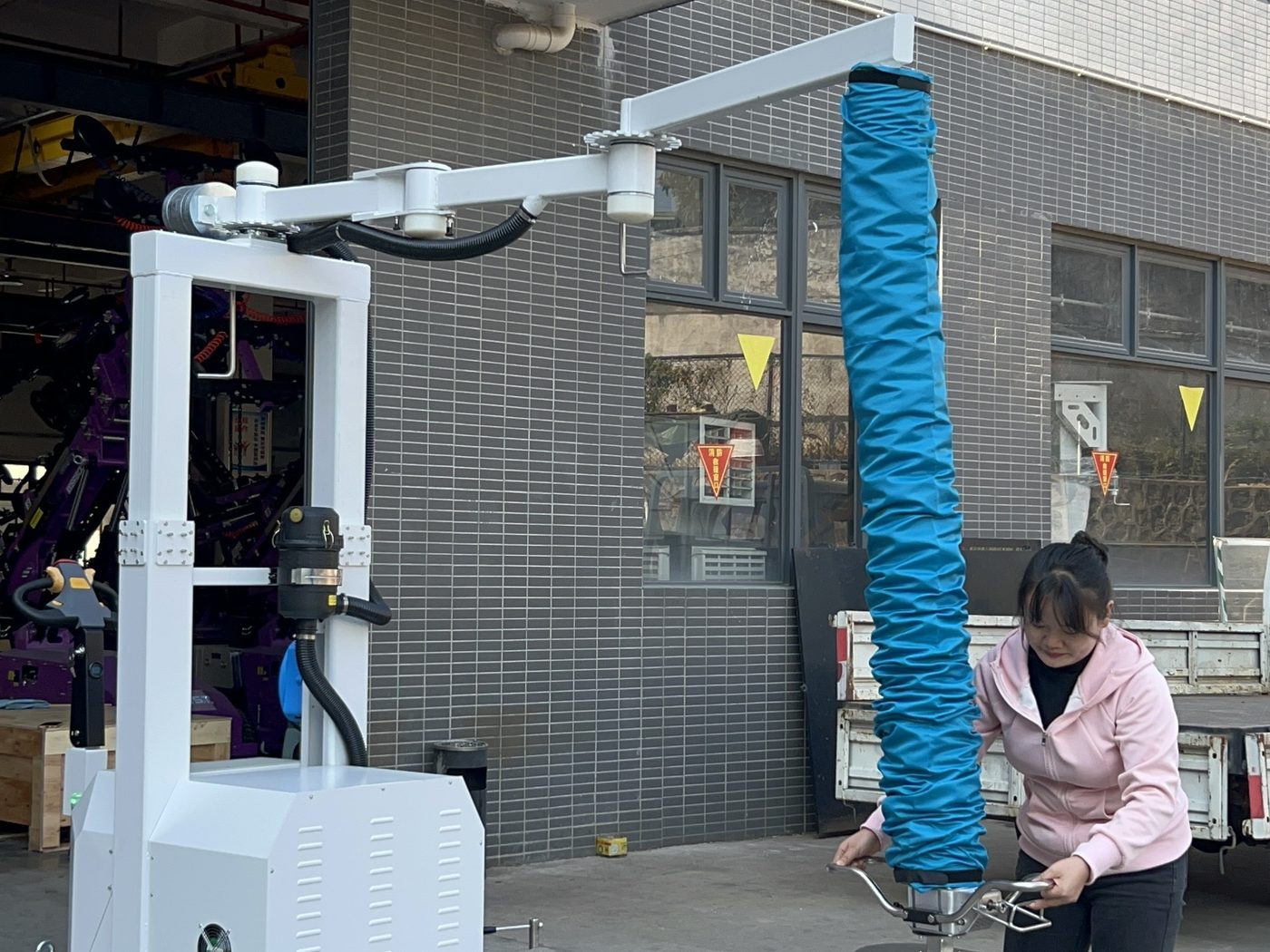
The site decides the crane, the overall height and the motor. Record the clear height to the underside of the beam, the working area or radius, the floor and its thickness, the power supply and the altitude.
| Parameter | What to check |
|---|---|
| Clear height | Lifter body plus crane or rail; tube lifters usually need at least 3.5–4 m of clear height, more with a longer stroke; the exact figure comes from the drawings |
| Working area | Every pick and place point must be inside the jib radius or the rail coverage |
| Floor and foundation | Pillar jib cranes need a concrete foundation or chemical anchors to the crane maker's drawing |
| Power supply | Voltage, phase and frequency differ by country: 60 Hz in Mexico, Brazil, Colombia, Saudi Arabia, Korea, the Philippines and the United States; 400 V 50 Hz in Germany, India, Australia and South Africa; 380 V 50 Hz in Vietnam |
| Compressed air | Only if an ejector-type vacuum source is used |
| Altitude | Thinner air means less vacuum: about 83% of capacity remains at 1,500 m and about 69% at 3,000 m |
Our standard supply is 380 V three-phase; other voltages and 60 Hz on request, confirmed before the order. Our WJC pillar jib cranes come with 2.5–4.0 m arms and 3.0–4.5 m columns, foundation drawing supplied with the order. The lifting systems page compares jib cranes and rails.
Step 5 – Configuration
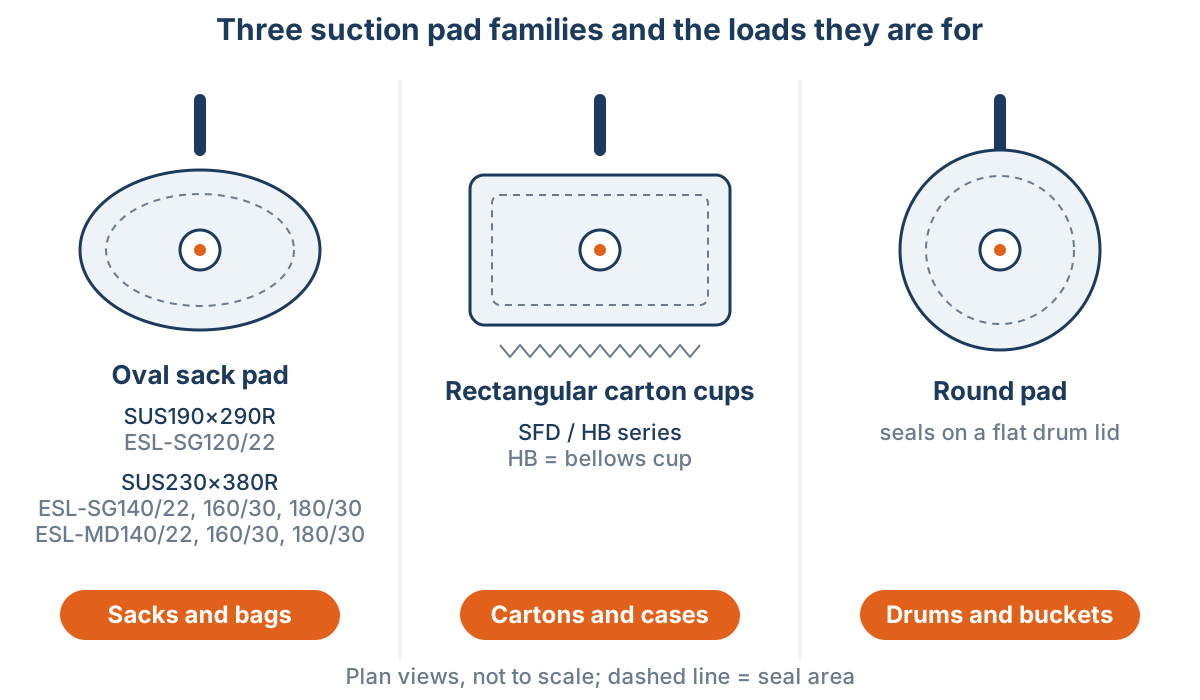
With the first four steps answered, the configuration follows: tube diameter from the derated weight, vacuum source from the porosity, pad from the load face, crane from the site. Two checks keep quotations honest.
| Tube diameter | At 30 kPa working vacuum | At 40 kPa | At 50 kPa | Typical brand rating |
|---|---|---|---|---|
| 120 mm | 35 kg | 46 kg | 58 kg | 35–50 kg |
| 140 mm | 47 kg | 63 kg | 78 kg | 45–60 kg |
| 160 mm | 62 kg | 82 kg | 103 kg | 60–70 kg |
| 180 mm | 78 kg | 104 kg | 130 kg | about 85 kg |
| 200 mm | 96 kg | 128 kg | 160 kg | 110–120 kg |
| 250 mm | 150 kg | 200 kg | 250 kg | about 200 kg |
| 300 mm | 216 kg | 288 kg | 360 kg | about 300 kg |
How to use it: a rating that sits near the 30–40 kPa columns is plausible; a rating that needs 50 kPa of continuous working vacuum before deducting the pad weight is optimistic and deserves a test report. Ratings for the same tube diameter differ by up to about 40% between makers, so compare ratings for the same load class.
Check 2: vacuum source. Porous loads need airflow, airtight loads need vacuum level; a high-flow source loses far less capacity between airtight and porous loads than a high-vacuum source. Pad: the standard pad is matched to the tube so that holding force exceeds lifting force by a safety margin, the pad sits fully on the face and over the centre of gravity, split tops get a double pad, slack sacks get a support mesh, long loads get a yoke. Crane: jib or rail according to the working area.
Next step: on our range the two-handle ESL-MD range 45–200 kg and the single-handle ESL-SG range 35–80 kg list every model with its rated capacity for airtight loads, blower and lifting height; the capacity calculator estimates lifting mass from tube size, porosity and altitude.
Rules of thumb and derating
| # | Rule | Basis |
|---|---|---|
| 1 | Porous loads such as paper sacks: estimate at 50–70% of airtight capacity, then confirm with a sample test | Experience |
| 2 | Semi-porous loads such as plain cartons and lined sacks: estimate at 75–90% | Experience |
| 3 | For porous loads choose a high-flow vacuum source first; do not simply enlarge the tube | Experience |
| 4 | Side picking and 90° tilting: use the tilt rating, commonly 15–35% below horizontal | Data |
| 5 | Altitude: about 17% less capacity at 1,500 m, about 31% less at 3,000 m | Data |
| 6 | Stroke ≥ highest place point − lowest pick point + 0.2 m | Experience |
| 7 | Stacking above about 1.8 m: a high-reach version or a long flexible handle | Data and experience |
| 8 | Uncoated woven, jute and cloth bags: assume vacuum is unreliable; test or use a mechanical gripper | Experience |
| 9 | Above 300 kg: outside the normal tube lifter range; move to vacuum lifting devices | Data |
| 10 | Dust, food, explosive atmosphere or cold store: a standard unit cannot simply be quoted | Compliance |
Rules 1 and 2 overlap with the porosity table in Step 1 on purpose: the table gives the planning range, the rules give the conservative starting point before the sample test.
Common selection mistakes
| Mistake | Consequence | Avoid it by |
|---|---|---|
| Sizing the tube on weight alone | Paper sacks cannot be lifted or have no margin | Classify porosity first, then derate |
| Enlarging the tube for porous loads instead of adding airflow | Still leaks, costs more, weighs more | High-flow source plus a skirted or foam pad |
| Ignoring tilt derating | Overload when side picking | Size on the tilt rating |
| Too little stroke or too high a stack | Top layer out of reach or hands above shoulder | Calculate stroke from the heights; high-reach version or long handle |
| Forgetting clear height and crane structure | The unit does not fit when it arrives | Clear height is a mandatory enquiry field; confirm with a layout drawing |
| Wrong voltage or frequency | Motor unusable or underperforming | Power supply is a mandatory field; stated on the order |
| No altitude derating | Not enough capacity on site | Apply the altitude factor |
| Standard unit sold into a dust zone | Serious safety and legal risk | Zone question is mandatory; no certification, no quotation |
| Assuming woven or jute sacks will hold | Dropped bags | Mechanical gripper or a real test |
| Food-contact parts without a declaration | Customer audit fails | Ask the supplier for material declarations |
| Indoor unit in a cold store or outdoors | Seal and tube behaviour unknown | Written temperature range from the maker |
| No wear parts or maintenance plan | Downtime complaints | Quote seals and filters with the machine; daily and weekly checks |
The selection checklist
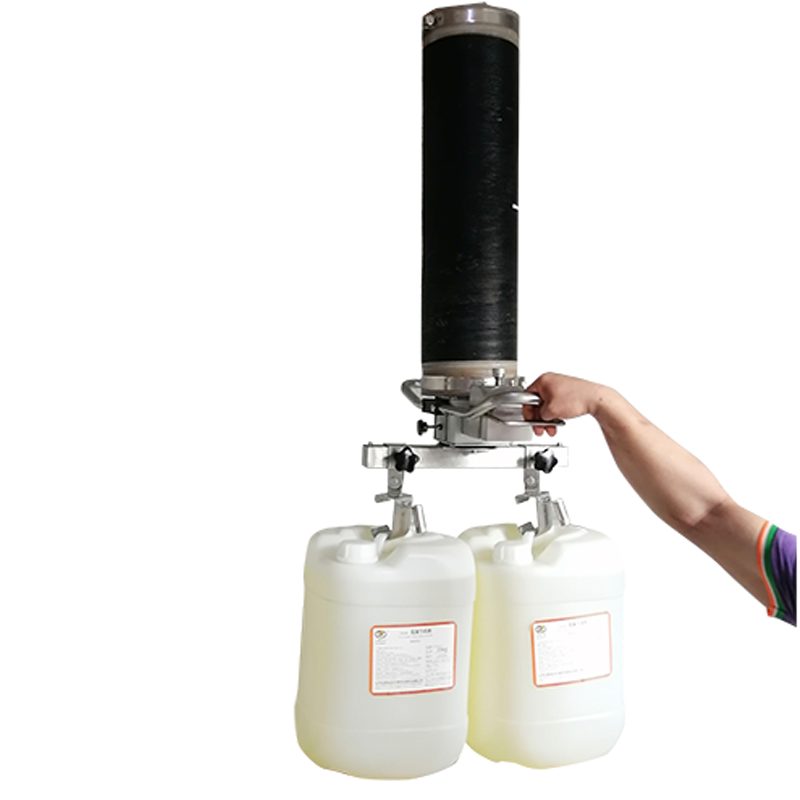
The checklist is the enquiry questionnaire we use ourselves: customer and end use, load, task, environment, site, and commercial and document requirements, with the mandatory items marked. Fill it in and our first reply can usually be a selection proposal, or a request for samples where the load needs testing, rather than a list of questions.
- Customer and end use: company, installation country, your role, end user, industry and end use
- Load: description, max and min weight, dimensions, packaging, liner or lamination, surface, fill level, temperature, samples available
- Task: pick and place heights, stacking height, lifts per hour and shifts, gripping direction, rotation or tilt, one or two hands
- Environment: indoor or outdoor, food contact, hazardous zone and dust type, cleanroom or washdown, corrosives
- Site: clear height, working area, mounting preference, floor, power supply, compressed air, altitude
- Commercial and documents: required certificates, manual language, quantity, lead time, Incoterms, photos and layout
the form follows the checklist; a photo of the load and the site is worth most of the questions.